

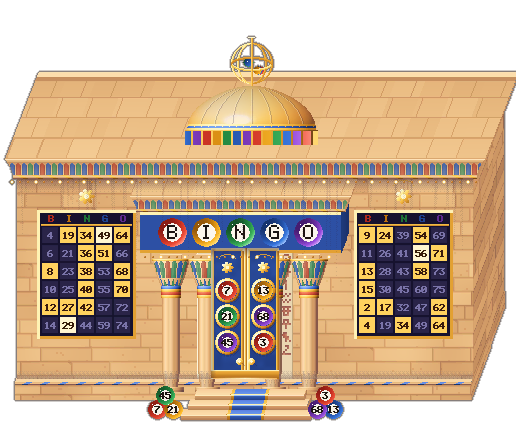
Seshat
The goddess of writing and measuring who laid out temples and counted the years — and the patron of our bingo hall.
Read more →Scribe of the gods, keeper of time and the patron of our blackjack hall. What the Egyptians said about him — and what the Greeks added later.
Thoth (Egyptian Djehuty) was the god of the moon, of reckoning, learning and writing. The Egyptians believed he invented writing, kept the records of the gods and spoke for the sun god Ra. He usually has the head of an ibis, sometimes appears as a baboon, and his chief city was Khmunu, which the Greeks called Hermopolis.
Among the gods he is the clever one: he counts, measures, writes things down and settles quarrels with arguments rather than spears. Britannica calls him the scribe, interpreter and adviser of the gods.
Look for the long, curved beak of an ibis on a human body. Thoth often holds a scribe’s palette and a reed pen, and he may wear the moon on his head: a disc resting on a crescent. The Met’s small Ptolemaic faience Striding Thoth shows the type well.
His second animal is the baboon, usually squatting, sometimes with the moon disc on its head. One of the most charming pieces in the Louvre is a statuette of the royal scribe Nebmeroutef from the reign of Amenhotep III: the scribe sits cross-legged with his papyrus, and a baboon of Thoth sits above him on a pedestal, watching him write.
Why an ibis? No Egyptian text explains it. The usual guess is the beak, curved like a crescent moon. With baboons the link is easier to see: they are noisy at sunrise, and the Egyptians showed them raising their paws to greet the sun.
On funerary papyri he stands by the scales with his palette. In the Papyrus of Ani he waits to write down the result while Anubis checks the balance.
In the Osiris myth Thoth protects the pregnant Isis, and when Seth wounds the eye of her son Horus, Thoth heals it. In a long story about the quarrel of Horus and Seth, written down some three thousand years ago, Hathor heals the eyes instead — Egyptian myths rarely keep to one cast. More on the Horus page.
This one is told by Plutarch, the Greek writer, around AD 100. The sky goddess Nut had been cursed so that she could not give birth in any month of the year. Thoth — Plutarch calls him Hermes — played draughts with the Moon and won from her a seventieth part of each of her periods of light. From his winnings he made five days outside the year, and on those days Osiris, Horus the Elder, Seth, Isis and Nephthys were born.
The story is Greek, but the five days are real. The Egyptian civil year had twelve months of thirty days plus five extra days at the end, and the Egyptians kept them as the birthdays of these gods. A god who wins time at a board game: you can see why we gave him a card hall.
In the myth of the Distant Goddess, the Eye of Ra quarrels with her father and goes off to the deserts of Nubia as a raging lioness. Somebody has to fetch her back. In a Demotic version it is Thoth, in the shape of a little baboon who calms her with fables; other texts send Shu or Onuris. The myth ties him to Hathor, one of the goddesses called the Eye of Ra.
A Demotic tale of the Ptolemaic period, the story of Setne Khamwas, describes a magic book written by Thoth himself and hidden in nested boxes at the bottom of the river near Coptos. Whoever read it understood the speech of birds and beasts and saw the gods. The prince who took it lost his wife and son. Setne, who wanted it next, played a board game for it against the prince’s ghost — and lost. Setne was based on a real man, Khaemwaset, son of Ramesses II, who restored old monuments; the 33rd of our 50 ranks, High Priest of Ptah, remembers him.
His great city was Khmunu in Middle Egypt, today’s el-Ashmunein. The name means “City of the Eight”, after the eight primeval gods of the local creation myth, and the town was the capital of the Hare nome, the fifteenth province of Upper Egypt. The Greeks, who saw Thoth as their Hermes, renamed it Hermopolis.
Across the river lay its cemetery, Tuna el-Gebel, with underground galleries for sacred animals and the tomb of Petosiris, a high priest of Thoth in the time of Alexander the Great. Ibises and baboons were buried there and at Saqqara near Memphis by the million.
Thoth was worshipped far from home too. In Lower Nubia the temple of Dakka belonged to Thoth of Pnubs, and in the Delta there was a second, smaller Hermopolis near today’s Baqliya.
Thoth was the patron of scribes, and in Egypt that meant the patron of the state. Tax lists, letters, temple inventories and royal decrees all passed through scribes’ hands. Few people could read — historians’ estimates run to about one Egyptian in a hundred — so the god of writing was also a god of power.
Kings took his name. Thutmose, the name of four pharaohs of the 18th dynasty, means “born of Thoth”.
He kept time as well. As a moon god he measured the months, and the Egyptians credited him with the calendar. At the judgment of the dead he was the clerk of the court: he wrote down the result of the weighing of the heart, and everyone who died hoped to have him on their side.
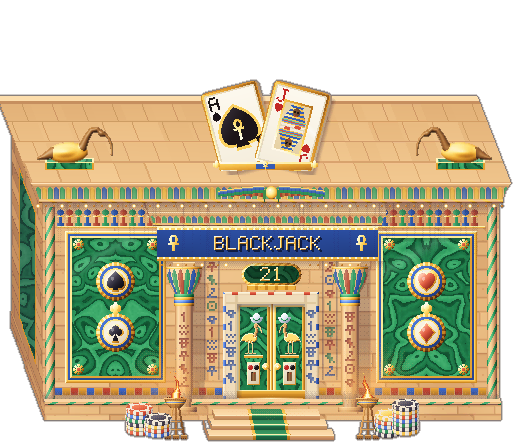
Thoth has a building of his own: the Hall of Thoth, where blackjack is played. It stands at the front right corner of the square, next to the sphinx. Its sandstone walls are faced with malachite panels the green of a card table, set with gold medallions of the four suits. Lotus columns frame the entrance, a gold cartouche with 21 hangs over the door, and on the roof sits a fan of cards: the ace of spades with a golden ankh and a jack in a pharaoh’s nemes. Golden ibises of Thoth rest at the corners.
Two more golden ibises with the moon disc guard the malachite doors, and below them are scribe’s palettes with red and black ink, the colours of the cards. Before you go in, the game greets you with: “Thoth keeps count for the gods — here you count to twenty-one.”
Inside there are six decks in the shoe, the dealer stands on all 17s, blackjack pays 3 to 2, and each table has five boxes with bets from 100 to 500,000 debens. The tables are named after places where Thoth was worshipped — Khemenu, Tuna, Wenet, Dakka, Pnubs, Saqqara, Ashmunein and Baqliya — so now you know what each name means.
His book is in the Treasury of Ra as well. In the Book of Thoth machine the book is both wild and scatter: three books open 10 free spins, and before they start Thoth picks a special symbol that can fill whole reels. New to blackjack? Start with our blackjack guides.
The Egyptians never explained it in writing. The usual suggestion is that the ibis’s curved beak recalls the crescent moon, and Thoth was a moon god. His other animal, the baboon, was tied to him just as closely.
Not originally. The Greeks in Egypt identified him with their Hermes, called him Hermes Trismegistos, “thrice great”, and renamed his city Hermopolis.
The sources differ. Many texts pair him with Seshat, the goddess of writing; in Hermopolis his consort was the goddess Nehmetawy.
In a Demotic story of the Ptolemaic period, a magic book written by Thoth himself that let its reader understand animals and see the gods. In Anubis City it is also a slot machine in the Treasury of Ra.
Yes. He measured time by the moon and often wears a lunar disc on a crescent. Egypt had other moon gods too, Khonsu of Thebes among them.
The goddess of writing and measuring who laid out temples and counted the years — and the patron of our bingo hall.
Read more →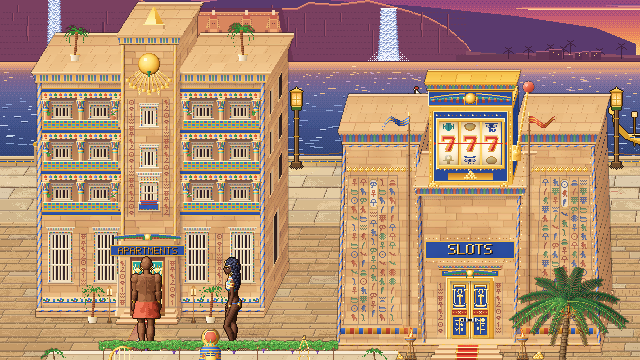
Type a name and get a pixel cartouche with every sound sign explained — and a PNG to keep.
Read more →
Play senet online against the computer or a friend, plus its history, the board, the rules and a step-by-step example.
Read more →The rules of our table, a basic strategy chart and trainer, and the numbers behind every move.
Read more →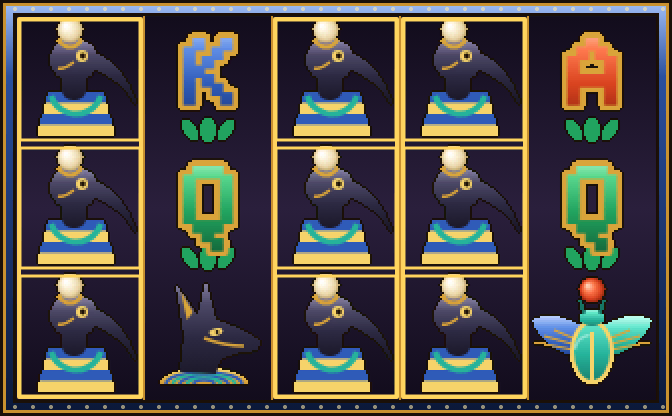
The book slot: paytable, free spins, the expanding symbol and a 95.20% return.
Read more →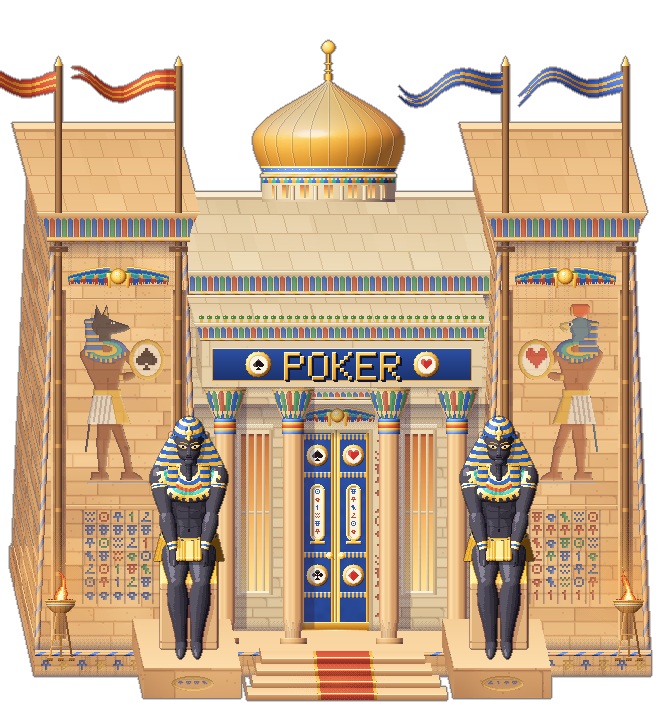
The malachite hall with the golden ibises stands at the front right of the square. Take a box, bet free debens and let the dealer deal.
Play free