

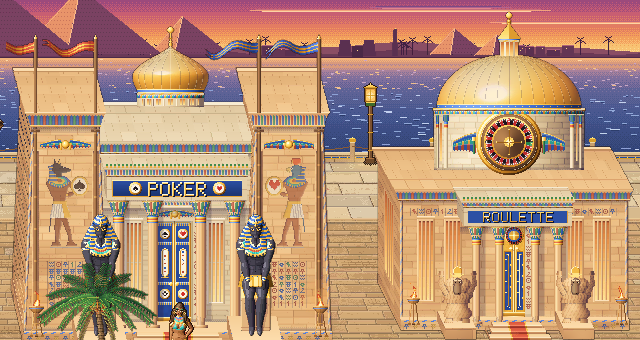
Ancient games
Senet, mehen, hounds and jackals, twenty squares, knucklebones and ball games: what we know and where to see them.
Read more →Three rows of ten squares, five pieces each and four throwing sticks. What we know about the oldest Egyptian board game — and a way to play it today.
Senet is a race game for two on a board of 30 squares in three rows of ten. Players move their pieces along an S-shaped track by throwing sticks, and the first to bear all of them off wins. Egyptians played it from about 3000 BC into Roman times. No rulebook survives, so every modern rule set is a reconstruction.
You can play right here, in the browser and without signing up: against the computer or with a friend on the same screen. Throw the four sticks, then tap a piece — the ones that can move are outlined, and the square they will land on lights up. The rules are those in the “How to play” section below: a pair cannot be hit, three in a row block the way, square 26 must be reached on an exact throw, and the House of Water sends a piece back to 15.
The computer plays a plain, sensible game: it bears off whenever it can, hits lone pieces, keeps its own in pairs and stays out of the water. Beat it once, then try the two-player mode with someone next to you.
The name comes from the Egyptian “znt”, “passing”. Fragments of boards that look like senet turn up in burials of the First Dynasty, around 3100 BC, and the first clear picture — a board drawn among other furnishings — is in the tomb of Hesy-Ra at Saqqara, around 2600 BC. Old Kingdom tomb walls then show people sitting over the board, mid-game.
By the New Kingdom the game had taken on a second meaning. Chapter 17 of the Book of the Dead shows the dead person playing senet against an opponent who is not there, and Queen Nefertari plays alone in a painting in her tomb. Peter Piccione, who studied the game for his doctorate, argues that senet came to stand for the soul’s passage through the underworld — the squares at the end of the track carry signs of rebirth and of the sun.
Tutankhamun went to his tomb with several game boxes: senet on one side, the game of twenty squares on the other, and drawers for the pieces, throwing sticks and knucklebones (W. J. Tait catalogued them in 1982). The game even made it into satire: a papyrus in the British Museum shows a lion playing senet against a gazelle. People scratched boards into stone wherever they sat and waited — some survive on the roof of the temple at Dendera. More on the boards and the Met’s collection in the museum’s article on senet and twenty squares.
The track snakes through the board: squares 1 to 10 along the top row, 11 to 20 back along the middle, 21 to 30 along the bottom. Each player has five pieces in most sets, sometimes seven — one side cone-shaped, the other shaped like spools. Instead of dice the Egyptians threw four flat sticks, light on one side and dark on the other, or knucklebones.
Here is what four fair sticks give, and how often. The numbers are our own calculation: each stick lands light side up half the time.
| Light sides | Squares | Chance | Again? |
|---|---|---|---|
| 1 | 1 | 25 % | yes |
| 2 | 2 | 37.5 % | no |
| 3 | 3 | 25 % | no |
| 4 | 4 | 6.25 % | yes |
| 0 | 5 | 6.25 % | yes |
So a 2 is the most common throw, and you get an extra throw 37.5 % of the time. Real sticks are rarely that fair: a flat side and a rounded side do not land equally often, which is one more reason ancient play may have felt different.
Five squares near the end are marked on New Kingdom boards, and square 15 often is too. The names below follow the reconstruction of the American Egyptologist Timothy Kendall (1978); other authors read the signs a little differently.
These rules are a modern reconstruction based on Timothy Kendall’s (1978), in the form many modern sets print. The Egyptians’ own rules have not survived and probably changed over two thousand years. Other reconstructions, such as R. C. Bell’s, differ in the details.
Cones stand on 1, 3, 5, 7 and 9, spools on 2, 4, 6, 8 and 10. The cones throw first.
After three turns the cones lead with a piece on 19, but look at the spools: two of them now stand side by side on 6 and 7. That pair cannot be attacked — the simplest defence in the game, and the first thing worth learning.
At the end of the track the race slows down. Say a cone sits on 26. A 1 sends it into the House of Water and back to 15 — a painful loss. A 5 takes it off the board at once. Holding a pair on 24 and 25 while you wait for the right throw is often worth more than rushing.
Soon the city will have a senet table: a game for two against a friend or another player, with the same reconstruction you can try on this page. We will announce it in the news when it opens; until then it is on our roadmap.
Meanwhile senet lives in the street: the slabs of the avenue of sphinxes in front of the halls have senet boards scratched into them (see the news), and the AI residents sometimes suggest a game after sunset. At home you can play on a printed board with five coins of each kind and four lolly sticks painted on one side. The other ancient games, from mehen to hounds and jackals, are on the page about the games of ancient Egypt.
Board fragments that look like senet come from burials of about 3100 BC, and the first clear picture of the board is from about 2600 BC. Egyptians played it until Roman times.
It is one of the oldest known. Mehen is about as old, early boards from the Levant and Mesopotamia are not far behind, and new finds keep shifting the dates, so nobody can name a single winner.
Five in most surviving sets, seven in some. Modern reconstructions usually play with five, set up alternately on squares 1–10.
Square 27 is the trap of the board: a piece that lands there is washed back to square 15, the House of Rebirth, and has to cover the last stretch again.
Yes, on this page: no download and no sign-up, against the computer or two players on one screen. The rules are a modern reconstruction by Timothy Kendall, explained step by step in the “How to play” section.
Soon: a senet table is coming to the city, against friends or other players and with the same rules as on this page. Until then you can play right here, against the computer or with a friend on one screen.
Senet, mehen, hounds and jackals, twenty squares, knucklebones and ball games: what we know and where to see them.
Read more →
Type a name and get a pixel cartouche with every sound sign explained — and a PNG to keep.
Read more →
Anubis, Thoth, Seshat, Hathor, Ra and Horus: who they were and where they live in our city.
Read more →
While the table is being made, walk along the avenue of sphinxes in front of the halls and look down: idle passers-by have scratched senet boards into the slabs.
Play free