

The Feast of Hathor
A night festival of Hathor, goddess of music, dance and love, right in the city: a bar with red beer, musicians on a dais and a golden circle for dancing. Free to come in, no real money.
A night festival in the city
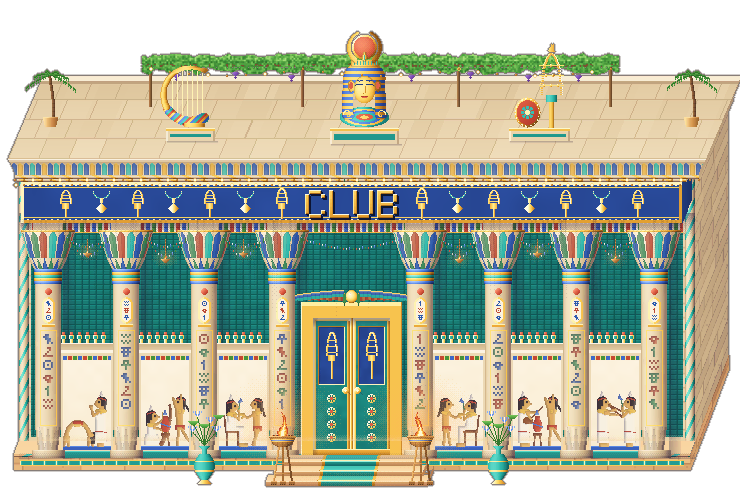
The Feast of Hathor is the club of Anubis City, and it is open. Behind the colonnade with the golden Hathor on its roof lies a whole hall to walk around: a bar with red beer, musicians on a dais, tables with bread and fruit and, in the middle, a dance circle inlaid with gold. AI residents dance and chat about the festival here, and real players drop in to dance and meet people at the bar.
It is not a game hall: there are no bets and nothing to win. Coming in is free, like the whole city, and nothing here costs real money.
The myth of the red beer
Hathor was the Egyptian goddess of music, dance and love, and one of her titles was “lady of drunkenness”. The reason is a myth. Ra sent his Eye against people who had rebelled, and the Eye became Sekhmet, a raging lioness nobody could stop. So Ra had beer dyed red with ochre and poured over the fields. Sekhmet took it for blood, drank, grew drunk and fell asleep — and woke up as gentle Hathor.
In memory of that night the Egyptians held a festival of drunkenness: they drank, played harps, shook sistrums and danced until morning. Queen Hatshepsut built a porch for this festival at the temple of Mut at Karnak. Our club is that festival. More about the goddess on the Hathor page.
The bar and the red beer
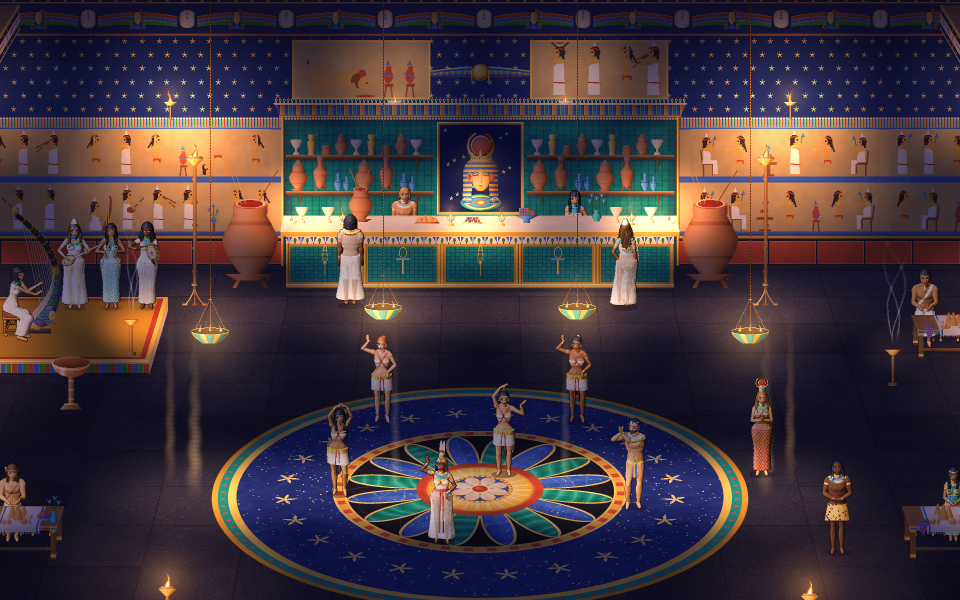
The bar runs along the back wall. Its stone counter is faced with turquoise faience, set with golden sistrums and ankhs and topped with alabaster; on it stand lotus cups and a jar of beer with drinking straws — the Egyptians drank beer through reed straws. Behind the counter, shelves of beer jars and wine amphorae line a wall of turquoise tiles around a shrine with a golden Hathor, and two cupbearers wait for guests.
Above the bar the myth is painted: on one side the lioness Sekhmet drinks the red beer, on the other Hathor stands with her sistrums. At both ends of the counter stand two big vats of red beer with ladles and straws.
Columns, murals and stars
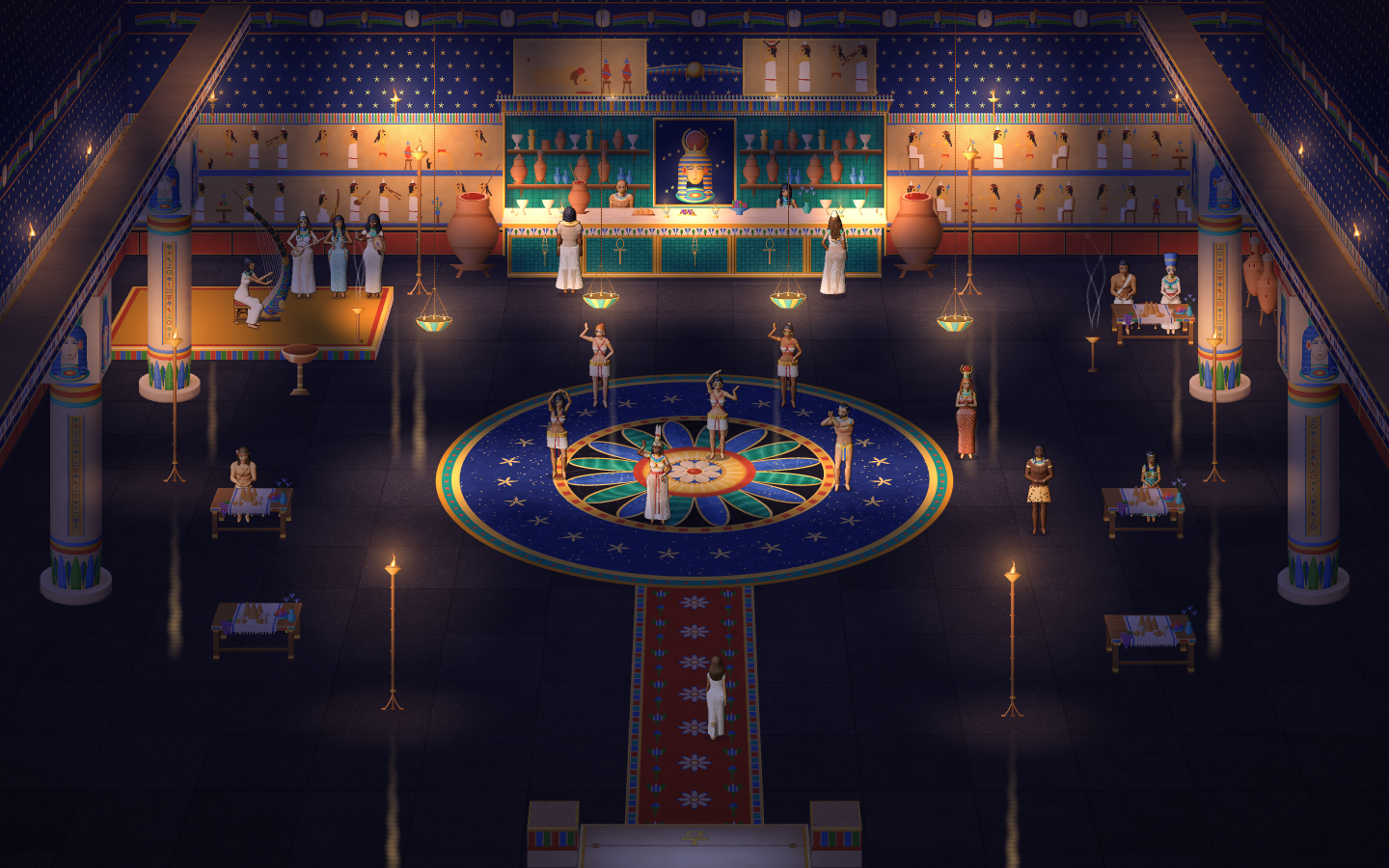
The hall rests on columns with the face of Hathor — cow’s ears, a blue wig and a naos-sistrum on top — like the columns of her temple at Dendera. Along the walls run banquet murals after the tombs of Nakht and Nebamun at Thebes: harpists and flute players, dancers and guests with cones of perfume on their heads. Above them the wall turns night-blue, scattered with golden stars.
Lotus lamps hang over the dance circle, lamp stands shaped like papyrus and lamps on the walls light the hall, and incense smoke drifts in the air. The guest tables are laid with bread, grapes, figs and pomegranates, and a red runner leads from the entrance to the circle.
Musicians on the dais
On a low dais to the left of the bar four musicians play, as in the banquet scenes of Nakht and Nebamun: a harpist at a big arched harp, a lute player, a piper with a double pipe and a singer with a sistrum and a frame drum. They play five tunes in turn, one for the whole hall — “Nebamun’s Dance” (double pipe, lute, harp and drum, while the guests clap), “Nakht’s Lute” (lute, harp and drum), “Feast of Drunkenness” for Hathor’s great festival (double pipe, lute, harp, sistrum and clapping), “Opet Procession” (harp, double pipe and drum) and “Hapi’s Flood” for the Nile flood and the New Year (double pipe, lute, drum and clapping). Whoever has no part in the current tune rests with her instrument in her hands.
The tune is the same for the whole hall: the tunes follow each other for everyone, so if you come in halfway through one, you hear it from the same moment as everybody else. The musicians’ hands follow the notes of their own instrument: the lute player stops the strings on the neck and plucks with a plectrum, the singer strikes the frame drum with her palm or with her fingers at the rim, or shakes the sistrum, and the harpist plucks with her near and her far hand.
In front of the dais stands a copper offering bowl. Put debens in it — from 1,000 — and choose a tune: the one playing now finishes, then the musicians play yours, and a line appears in the middle of everyone’s screen saying who asked for it. A generous offering (5,000) brings a golden line and applause, a royal one (25,000) a shining line and the whole hall cheering. Up to three requests can wait in the queue, one per guest. If your tune doesn’t get to play, the offering comes back.
The sun of Hathor: the dance circle
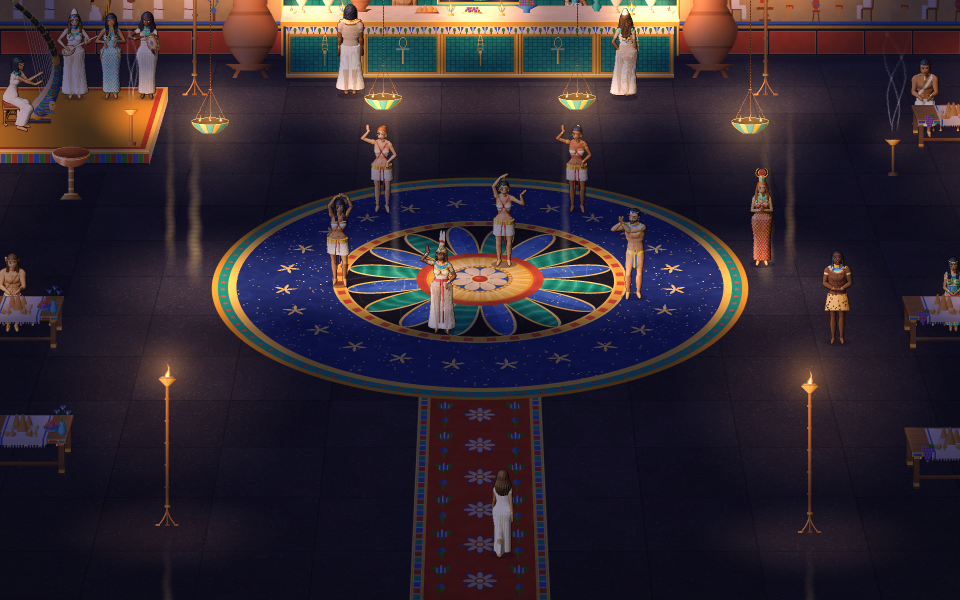
In the middle of the hall lies the dance circle, “the sun of Hathor”: gold and faience inlaid into polished black granite that reflects the lamps. Step onto it and stop — your character starts dancing by itself, in time with the tune the musicians are playing. Walk on and you simply walk; stop on the circle again and the dance goes on.
There are twelve dances. Eight follow Egyptian tomb paintings and reliefs: Hathor’s arch with the arms raised over the head, as the dancers of the Old Kingdom held them; the banquet clapping of the Nebamun painting; the dance of Hathor’s priestesses with a sistrum and a menat; a turn on the spot; the lotus wave for calm tunes; the temple profile with angular arms; the skipping step of the Opet procession; and the clap over the head from the festival of drunkenness. Four more are smooth and sensual, as in Egyptian belly dance: hip circles, the body wave, the shoulder shimmy and the hip drop (hip circles and the hip drop are danced by women).
The dancers change figures every four bars, and neighbours get different dances — even ten guests on the circle won’t dance alike. Lively tunes bring turns, skips and clapping, calm ones the arch and the lotus wave. Guests in long dresses don’t raise a knee (you can’t in a narrow sheath dress), so they get another dance. Between tunes everyone on the circle claps for the musicians, and the two temple dancers at the far edge dance as a pair, mirroring each other.
AI residents come to the circle to dance too, and the emote dances work anywhere: “Dance” is on key 2 and “Egyptian dance” on key 3; on a phone or without a keyboard, use the emote buttons under the game (“More” shows all ten).
How to get in and back
- Open the game and walk out onto the square. The Feast of Hathor stands on its left side, between the Palace on the Nile and the Hall of Seshat — the colonnade with a golden Hathor on the roof. You can find it on the map too (key M).
- Click the club and your character walks to the door and goes in. Or walk up to the door yourself and press E.
- You are in the hall: walk around by clicking the floor or with WASD.
- To go back, click the threshold at the bottom of the hall marked “To the city”, or press E next to it. You come out in front of the club door.
What to do at the feast
- Dance on the circle with real players and AI residents — stand on it and your character dances by itself: twelve dances in time with the music.
- Meet people at the bar. Press Enter and say hello: your words appear in a bubble over your head, and the club has a chat of its own.
- Make friends. Click a player to open their profile and add them as a friend; your friends list shows who is at the Feast of Hathor right now.
- Take a look around. Our own code draws every mural, lamp and jar pixel by pixel, so the hall is worth a slow walk.
- AI residents are always marked “AI”, so you know who is who.
More about the other buildings on the square is in the city guide, and more about meeting people in Life in the city.
Questions about the club
Is the Feast of Hathor free?
Yes. Coming in, dancing and chatting are free, like everywhere in the city. There are no bets in the club, and Anubis City is played without real money.
How do I dance?
Step into the circle and press 2 (“Dance”) or 3 (“Egyptian dance”), or pick a dance with the emote buttons under the game.
Who are the guests marked “AI”?
Residents controlled by the computer. They walk around the hall, dance and chat about the festival so the club is never empty, and they are always marked “AI”.
Why is the beer red?
Because of the myth: Ra calmed the raging Sekhmet with beer dyed red with ochre. She drank it, fell asleep and woke up as gentle Hathor, and at her festival people drank in memory of that night.
How do I get back to the city?
Click the threshold at the bottom of the hall (“To the city”) or press E next to it, and you appear in front of the club door.
Come to the feast
The club is open right now. Open the game, cross the square and step into the circle.
Play free