

Ranks and titles
All 50 ranks of the game: real Egyptian titles, what they meant and how much experience each one needs.
Read more →How Egyptians priced bread, goats and coffins in copper they rarely handed over — and why the coins of Anubis City are called debens.
The deben was a unit of weight, not a coin. In the New Kingdom it weighed about 91 grams and was divided into ten kite (qedet) of about 9.1 g. Egyptians stated prices in debens of copper — sometimes of silver or gold — but usually paid with other goods worth the same amount.
We know the weight from the stone weights found in excavations: UCL’s Digital Egypt gives the New Kingdom standard as one deben of 91 g in ten qedet. Earlier debens were lighter — Old and Middle Kingdom weights point to units of roughly 13 to 27 grams — so prices from different periods cannot simply be compared.
Grain had its own measure, the khar, a sack of about 77 litres. Silver was also counted in the senyu, a twelfth of a deben (about 7.6 g). In village accounts of the 13th–12th centuries BC a khar of grain was usually reckoned at 2 debens of copper — the most stable price we know.
The best price list from ancient Egypt comes from Deir el-Medina, the village of the craftsmen who cut the royal tombs in the Valley of the Kings. Thousands of ostraca — notes on potsherds and limestone flakes — record sales, loans and swaps of the 13th and 12th centuries BC. The Dutch Egyptologist Jac. J. Janssen gathered them in “Commodity Prices from the Ramessid Period” (1975).
| Item | Typical value | Where the figure comes from |
|---|---|---|
| A sack (khar, about 77 l) of grain | 2 debens of copper | Janssen 1975 |
| A plain linen garment | about 5 debens | Janssen 1975 |
| A goat | 2–3 debens | ostracon Deir el-Medina 73 |
| A pig | 5 debens | the same ostracon |
| A donkey | 20–40 debens | Museo Egizio, Turin |
| A plain coffin | about 25 debens — roughly a donkey | ostracon Deir el-Medina 73; Museo Egizio |
| A young Syrian slave | 4 debens 1 kite of silver | Papyrus Cairo 65739 |
Treat these as typical values, not a price list. The same goat could change hands for 2 debens in one deal and 3 in another, and round numbers — 5, 10, 20 — turn up suspiciously often.
Wages were paid in grain. A workman at Deir el-Medina received four sacks of emmer and one and a half of barley a month (Jaroslav Černý, “A Community of Workmen at Thebes”, 1973). If every sack is counted at 2 debens — our rough calculation — that is about 11 debens a month, and a donkey cost two to four months of a workman’s grain. No wonder villagers often hired donkeys instead of buying them.
Ostracon Deir el-Medina 73 records the purchase of a coffin valued at 25½ debens. The buyer paid with copper worth 13½ debens, a pig counted at 5, two goats at 3 and 2, and two logs of sycamore wood at 2. Nobody handed over 25½ debens of metal. The scribe’s job was to make both columns add up to the same number.
Bigger deals worked the same way in silver. Papyrus Cairo 65739, published by Alan Gardiner in 1935, tells how a woman named Erenofre bought a young Syrian girl from a merchant for 4 debens 1 kite of silver. She paid with linen — a shroud, a blanket, garments and shirts — bronze vessels, a jar of honey and copper, each item valued in silver. We know the deal only because it ended up in court.
The same papyrus gives a rate: ten debens of copper counted as one kite of silver, so silver was worth about a hundred times its weight in copper. Rates moved; by Janssen’s figures, by the late 12th century BC silver had fallen to about sixty times the value of copper.
Paying in goods worked for well over two thousand years. Greek silver coins reached Egypt through trade in the Late Period, but they were usually weighed like any other piece of metal. The last native kings, in the 4th century BC, struck a small gold coin with the hieroglyphs for “good gold”. Coins became everyday money only under the Ptolemies, after Alexander the Great.
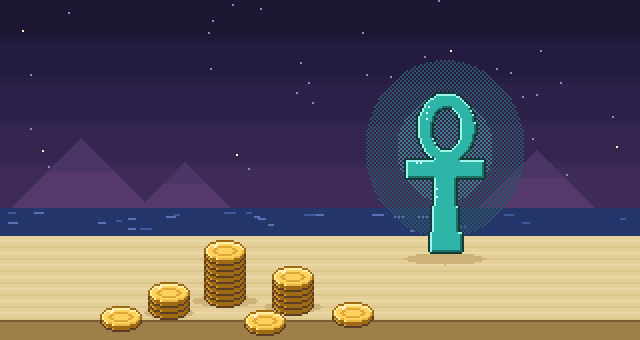
Because the deben was the Egyptian way of saying “this is worth so much”, and that is exactly what our coins do. In Anubis City the deben has finally become a coin you can hold:
Debens are for play only. They cannot be bought back, cashed out or exchanged for money or prizes — see rewards.
The ankh is the hieroglyph for “life”: a loop above a cross. Gods hold it out to the king in temple reliefs, often right at his nose, giving him the breath of life. What the sign first pictured is disputed: Alan Gardiner thought it was a sandal strap — the Egyptian word for one sounded the same — while others see a knot. Later the Copts took it up as a form of the cross (Britannica).
In Anubis City the ankh is everywhere: in the hand of Anubis the Guardian above the fountain, on the reels of the Sevens of Ra slot, as a wrapping for gifts. It is also the city’s second coin — the turquoise counter next to your debens. For now it shows zero. Ankhs will not be won at the tables: they are planned as rewards for levels, achievements and city festivals, and they are on the roadmap, not in the game yet.
There is no honest conversion. A deben was 91 g of copper, and the metal alone is worth very little today; it is better to compare goods: 2 debens bought a sack of grain, 20–40 bought a donkey.
Not for most of their history. Prices were reckoned in debens and paid in goods; the first Egyptian coins were struck in the 4th century BC, and coins became common only under the Ptolemies.
A tenth of a deben, about 9.1 g in the New Kingdom. Silver prices were often given in kite, because a whole deben of silver was a large sum.
Debens are not on sale at the moment, and they can never be cashed out or exchanged for money or prizes. They come from your starting purse, the gift for saving your character, Ra’s Boat, new levels and your wins.
It is our invention. The ankh was the Egyptian sign of life, never money; we chose it for the rare coin because it is the best-known Egyptian symbol after the pyramids.
All 50 ranks of the game: real Egyptian titles, what they meant and how much experience each one needs.
Read more →
Senet, mehen, hounds and jackals, twenty squares, knucklebones and ball games: what we know and where to see them.
Read more →
Anubis, Thoth, Seshat, Hathor, Ra and Horus: who they were and where they live in our city.
Read more →
100,000 debens are waiting at the gate, and Ra’s Boat brings more to the quay every ten minutes.
Play free