

Ranks and titles
All 50 ranks of the game: real Egyptian titles, what they meant and how much experience each one needs.
Read more →Type a name, see it spelled with the Egyptian one-consonant signs inside a cartouche, and keep it as a picture.
Type your name below. The tool breaks it into sounds and writes each one with an Egyptian sign that stands for a single consonant — the way Egyptologists spell foreign names in hieroglyphs. It is a sound spelling, not a translation: the signs say how your name sounds, not what it means.
This is a simplified spelling. Egyptian writing left out most vowels; we keep them so you can recognise your name. A scribe would have picked his signs differently, and a cartouche was reserved for kings and queens — here it is simply a frame.
Three signs of the old “alphabet” never appear in your name: the forearm (ʿ, a throaty sound like the Arabic ayin), the twisted wick (ḥ, a breathy h) and the animal’s belly (ẖ, a softer kh). English and Slavic names simply have no such sounds.
Hieroglyphs were never an alphabet. They mix three kinds of signs. Some stand for a whole word: a sun disc means “sun”, a house plan means “house”. Others stand for sounds — one, two or three consonants. The rest, determinatives, are not read at all: they show what kind of word you are looking at.
The Egyptian word for cat is a good example. It is written owl (m) + reed (i) + quail chick (w) — “miw”, a cat’s own sound — and then a little picture of a cat that is not pronounced. The cat at the end tells the reader that “miw” here is the animal.
Classical Middle Egyptian used around 750 signs; in the temples of the Ptolemaic period their number grew into the thousands. Vowels were not written, so nobody knows exactly how most words sounded. Texts ran in rows or columns, usually from right to left, and the animals and people always face the beginning of the line — that is how you tell the direction.
The oldest hieroglyphs we know are labels from a tomb at Abydos, about 3200 BC. The last dated inscription was carved at Philae in AD 394. After that nobody could read the script for fourteen centuries.
A cartouche is an oval of rope with a knot at one end, drawn around a royal name. The Egyptians called it “shenu”, from the word for “to encircle”: it grew out of the round shen ring, a sign of protection and eternity, stretched to fit a long name. Kings used it from about 2600 BC, at the turn of the 3rd and 4th Dynasties.
A pharaoh had five names, and two of them went into cartouches: the throne name and the birth name. Queens and some royal children got cartouches too; ordinary Egyptians never did. The word itself is French — scholars of Napoleon’s expedition of 1798–1801 thought the oval looked like a gun cartridge (Livius).
Names in cartouches were the key to the script. The Rosetta Stone, found in 1799, carries one decree of 196 BC in hieroglyphs, demotic and Greek. The Greek text names King Ptolemy, and the English scholar Thomas Young worked out that the cartouche in the hieroglyphic part held the same name.
Then came a second name. William Bankes brought an obelisk from Philae to his house in Dorset: its base carried a Greek inscription mentioning Cleopatra, and the shaft had a cartouche to match. Jean-François Champollion compared the two names sign by sign. The stool (p), the lion (l), the reed and the rope loop stood in the places where Ptolemaios and Kleopatra share sounds. But t was a loaf of bread in Ptolemy and a hand in Cleopatra — so two different signs could write the same sound.
From these comparisons Champollion built a list of sound signs and presented it in Paris on 27 September 1822, in his letter to Bon-Joseph Dacier. The decisive step came when the same signs read native Egyptian names too — Ramesses, Thutmose. Hieroglyphs were not just symbols: they wrote sounds.
Real spellings: Ptolemy is p-t-w-l-m-y-s, and Cleopatra is q-l-i-w-p-a-d-r-a-t, ending with signs that mark a woman’s name. Type Cleopatra into the tool above and compare: our version uses a basket for C and a loaf for T, where the scribe chose a hill (q) and a hand (d).
No. The tool writes the sounds of your name with Egyptian sound signs. A translation would need an Egyptian word with the same meaning, and most modern names have none.
Egyptian had no v and no l. The closest sound to v is f, written with the horned viper, and for l in Greek names scribes used the lying lion.
Ours reads from left to right, and the birds face left — towards the start of the line. Egyptians more often wrote from right to left, and then every sign faced right.
You can, but remember it is a simplified spelling made by a program. For anything permanent, ask an Egyptologist to check it — there is often more than one good way to write a name.
No. Cartouches were for kings, queens and some royal children. An ordinary name was written plainly and ended with a determinative — a seated man or woman, which you can add in the tool.
All 50 ranks of the game: real Egyptian titles, what they meant and how much experience each one needs.
Read more →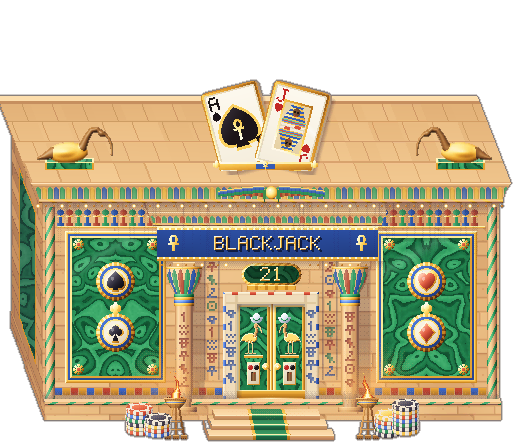
The ibis-headed scribe of the gods, lord of the moon and of reckoning — and the god of our blackjack hall.
Read more →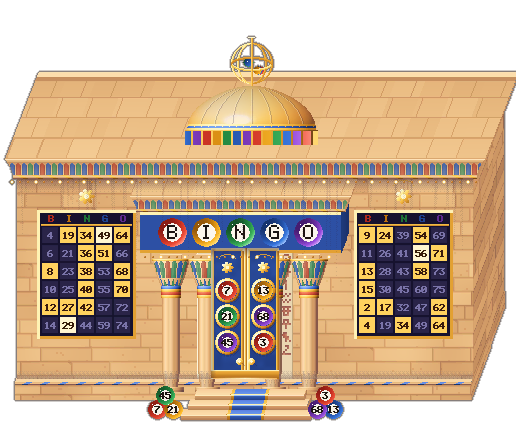
The goddess of writing and measuring who laid out temples and counted the years — and the patron of our bingo hall.
Read more →
Play senet online against the computer or a friend, plus its history, the board, the rules and a step-by-step example.
Read more →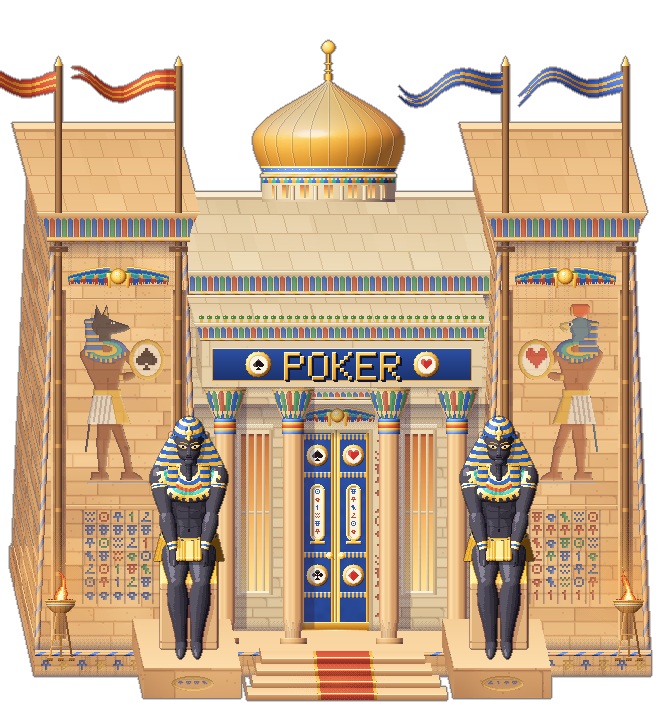
The pylons of the Treasury of Ra are covered from top to bottom with painted hieroglyphs and royal cartouches. Walk up and take a close look.
Play free