

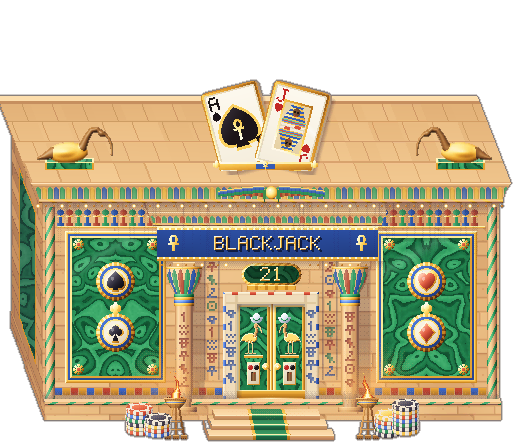
Thoth
The ibis-headed scribe of the gods, lord of the moon and of reckoning — and the god of our blackjack hall.
Read more →Lady of books, of temple plans and of counted years. You meet her on many temple walls — and on the doors of our bingo hall.
Seshat was the Egyptian goddess of writing, measurement and records; her name means “the female scribe”. She is shown as a woman in a leopard skin with a seven-pointed star under an arch on her head. She helped the king lay out new temples, wrote down the years of his reign and counted tribute and the spoils of war.
Britannica calls her “the ruler of books”. She has almost no adventures. Seshat is a goddess of work, and you see her with a reed pen in her hand, not a spear.
Her emblem is the clearest clue: a star or rosette with seven points on a short pole, with an arch above it shaped like an upturned bow or a pair of horns. The same sign was used to write her name, so when you see it on a woman’s head you can read “Seshat” without a single other hieroglyph. What it actually shows is still debated — a star, a flower, or something else.
Over her dress she wears a leopard skin with the tail hanging to her feet. That garment normally belonged to priests, so a goddess wearing it stands out at once. In her hands she holds a reed pen or a palm rib cut with notches: the hieroglyph for “year”, and her tally of the king’s reign.
The Met has a painted limestone head of a goddess from the early 18th dynasty that the museum believes is most likely Seshat.
Her best-known task was the founding of temples. In the rite of “stretching the cord”, the king and Seshat face each other, each driving a stake into the ground with a mallet, and the cord between the stakes fixes the line of the new walls. Britannica notes that the orientation could be taken from the stars, and Seshat was the expert at sighting them. Scenes of the rite run from the early kings down to temples of the Roman period, Edfu and Dendera among them.
Seshat kept the king’s time. On temple walls she notches a palm rib to record the years of his reign and his jubilee festivals. In New Kingdom reliefs she writes, with Thoth and the god Atum, the king’s name on the leaves of the sacred ished tree of Heliopolis, so that the name would last as long as the tree. A famous example is in the Ramesseum, the temple of Ramesses II at Thebes.
She also kept the accounts. Old and Middle Kingdom reliefs show her writing down the numbers of foreign captives and animals taken in war. One such scene, from the mortuary temple of King Sahure at Abusir, was copied on the walls of later kings.
Seshat is closely tied to Thoth, the god of writing, but the texts disagree about how: in some she is his wife, in others his daughter. Britannica calls her his consort and says both were divine scribes.
Egyptologists know of no great temple dedicated to her alone. Seshat lived on the walls of other gods’ temples, in the scene of their founding. Her title “Mistress of the House of Books” ties her to temple libraries, where the priests kept the sacred texts.
If you want to see her for yourself, look for foundation scenes: she stands facing the king with a stake and a cord, at Karnak, Edfu and Dendera.
As far as we know, Seshat had no popular cult of the kind Hathor had. She belonged to the world of the state: architects, temple scribes, the king’s officials. If you were a scribe in a temple “House of Life”, the library and workshop where texts were copied, Seshat and Thoth were your patrons.
Several of our ranks come from that world: the 20th, Scribe; the 24th, Scribe of the House of Life; the 25th, Royal Scribe. Their stories are on the page about the 50 ranks.
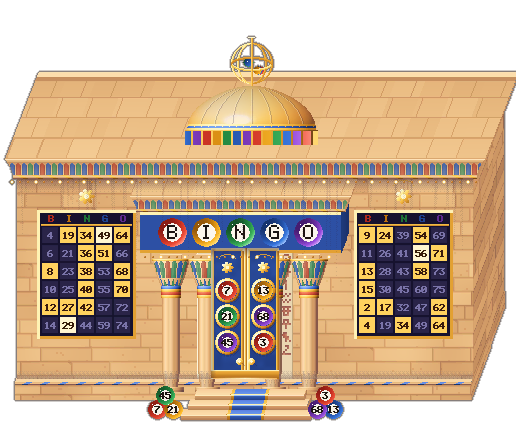
Her name is on the Hall of Seshat, where 75-ball bingo is played. It stands at the front left corner of the square, opposite the Hall of Thoth, so the two scribes face each other across the fountain.
Look at the front. Between papyrus columns hangs a sign that spells BINGO in coloured balls, and on either side of the door are two great boards of numbers. Above each board shines her emblem in gold: the seven-pointed star under its arch. The lapis doors carry coloured balls with numbers in gold settings — 7, 21 and 45 on one leaf, 13, 68 and 3 on the other — with a golden star of Seshat above each column. On the golden dome turns a lottery cage.
Why bingo? Seshat counted and wrote down numbers for the gods. In her hall the caller does the same: every ball drawn goes up on the board, and the cards mark it. AUTO halls mark the numbers for you; in MANUAL halls you mark them yourself and press “BINGO!” in time. Prizes go to a line and to the whole card, and AI regulars like to shout “Bingo! Seshat wrote my name today!”
Rules are on the bingo page; winning patterns and the odds are in our bingo guides.
The Egyptian goddess of writing, measurement and records; her name means “the female scribe”. With the king she measured out new temples, and she recorded the years of his reign.
In some texts, yes; in others she is his daughter. Britannica describes her as his consort, and both were divine scribes.
A star or rosette with seven points on a pole, under an arch like an upturned bow or horns. It was used to write her name; what it depicts is still debated.
It was the foundation rite of a temple: the king and Seshat drove stakes into the ground and stretched a cord between them to fix the lines of the walls, sometimes by the stars.
Because she counted and recorded numbers for the gods, which is exactly what the caller and the board do in bingo. Her golden stars shine above the boards and on the doors of the hall.
The ibis-headed scribe of the gods, lord of the moon and of reckoning — and the god of our blackjack hall.
Read more →
Type a name and get a pixel cartouche with every sound sign explained — and a PNG to keep.
Read more →
All 50 ranks of the game: real Egyptian titles, what they meant and how much experience each one needs.
Read more →
The hall with BINGO in coloured balls stands at the front left of the square. Buy a card with free debens and watch the board fill up.
Play free