

How to play
Rules of 75-ball bingo, auto and manual halls, and an example game ball by ball.
Read more →Fourteen common 75-ball shapes, drawn on the card, with the average number of balls before someone wins — for one card and for a hall full of them.
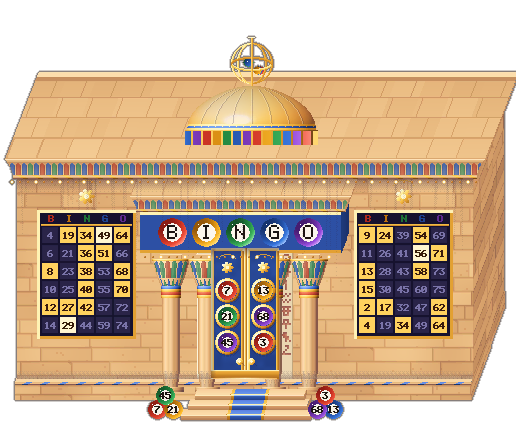
A bingo pattern is the shape you must cover on the 5×5 card to win: a line, four corners, a 2×2 postage stamp, an X, a frame or the whole card, called blackout. The fewer numbers a shape needs and the more ways it can be made, the sooner it comes. In our halls two patterns pay: any line and the full card.
Each tile shows one way to make the pattern — the star is the free space — and the average ball on which the first card completed it, with 1, 4, 15 and 50 cards in play. Every figure comes from 200,000 games played with the card and ball functions of our own game.
Four corners needs only four numbers, yet on one card it takes almost 61 balls. An ordinary line needs four or five and takes 41. The difference is choice: there is one set of corners, but there are twelve lines, and whichever finishes first wins. The postage stamp sits in between — four numbers, four corners to choose from, about 47 balls.
The X, the plus, the T and the inner square each need eight numbers, and on a single card they all take 67.6 balls. For any fixed shape of k numbers there is an exact formula: on average it completes after k × 76 / (k + 1) balls. For k = 8 that is 67.56; for the corners, k = 4, it is 60.8; for blackout, k = 24, it is 72.96. Our simulation matched every one of them to the second decimal, which is a good sign the rest of the table is right.
With 50 cards in play any line goes at ball 18.5 instead of 41.4, but blackout only moves from 73 to 64.9. On a small shape luck varies a lot from card to card, so among fifty cards there is almost always an early one. A blackout needs 24 numbers out of 75, and every card has to wait for most of the drum whatever happens.
For every game the script shuffles the 75 balls and deals 50 cards with the same functions our server uses, then notes the ball on which each card completes each pattern. The earliest card wins; the first 1, 4 and 15 cards give the smaller games. With 200,000 games the averages are good to a few hundredths of a ball.
On one card a horizontal line and a vertical line both take 48.4 balls. With 50 cards in play rows come at ball 23.0 and columns at 24.1. The reason is the layout: every card’s B column draws from the same fifteen numbers, so columns on different cards tend to fill together, while a row mixes all five ranges and spreads the luck more. The same effect makes the X slightly quicker than the plus in a big game, 45.7 against 46.3.
We pay for any line — any of the twelve — and for the full card. In a typical game with 11 to 14 cards, the Line goes at about ball 25 and the Full card at about ball 68, and the pot splits 30% to 70%. We picked these two because they need no explaining. Nobody has to learn what a crazy kite is to see that they have won, and the game moves straight from one prize to the next.
Halls that run long sessions change the pattern every game. If you host bingo at home, a varied list keeps the evening lively: a quick line to warm up, a postage stamp, an X, and a blackout to finish. Print the cards with our card generator and see how to play for the basic rules.
Here is a running order we like for a home game with about 15 cards in play, with the average number of balls for each game taken from the tiles above.
That is around 206 balls in all. At five seconds a ball, with a minute to check each winner, the evening takes about 22 minutes. Announce each pattern before the first ball and leave it on the board, and keep the called slips in order: on a blackout you will be checking 24 numbers.
Any line. With twelve ways to make it, one card completes a line after 41 balls on average, sooner than any other shape on our list.
Covering all 24 numbers on the card. One card needs 73 of the 75 balls on average; with 50 cards in play the first blackout comes at about ball 65.
Yes, whenever the shape passes through the centre: lines, the X, the plus and the T. That is why lines through the middle need only four numbers.
On one card, no — both take 48.4 balls. With many cards in play rows win slightly sooner: 23.0 against 24.1 balls with 50 cards.
Any line, worth 30% of the pot, and the full card, worth 70%.
Rules of 75-ball bingo, auto and manual halls, and an example game ball by ball.
Read more →American bingo, British tickets and Russian lotto side by side, with average calls to a win.
Read more →Free printable 75-ball bingo cards, one to six per page, with a caller’s sheet.
Read more →Legs eleven, two fat ladies and the sayings of Russian lotto, with honest notes on their origins.
Read more →
See both prizes go in the Hall of Seshat — a new game starts every few minutes, with free debens.
Play free