
Ranks and titles of ancient Egypt

Fifty real titles from the bottom of Egyptian society to the throne: what they meant, when they were used and how to earn each one in Anubis City.
How Egyptian titles worked

Ancient Egypt had no single ladder of ranks. An official collected titles over a lifetime and carved them on his tomb: a rank at court such as Sole Companion, an office such as Overseer of the Treasury, a priesthood or two. Anubis City lines up 50 of these real titles from commoner to pharaoh — one for each level.

Egyptologists sort titles into three kinds. Ranking titles — “iry-pat”, “haty-a”, “Sole Companion” — showed how close a man stood to the king. Office titles named the job: scribe of the fields, mayor, vizier. Priestly titles told which god he served and how. A tomb inscription often reads like a CV, with the honours at the front and the offices after them.

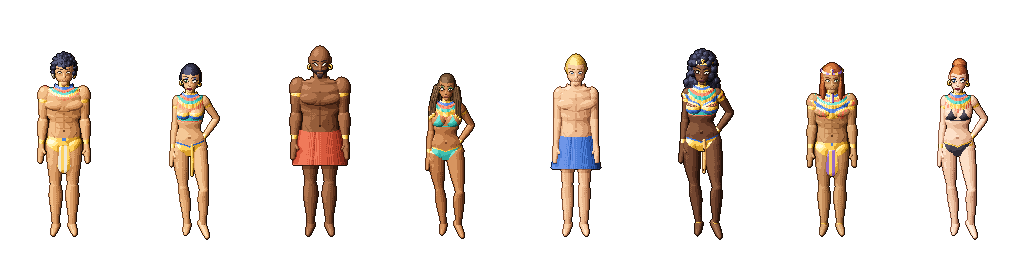
Women had fewer offices open to them, but not none. Noblewomen of the Old Kingdom served as priestesses of Hathor and Neith, the God’s Wives of Amun governed Thebes in the first millennium BC, and Hatshepsut ruled as pharaoh. In the game, a female character gets the feminine form of her rank where it exists: Wab Priestess, Lector Priestess, God’s Wife of Amun.

Our order is a game ladder, not a real table of ranks: in one century a mayor outranked a general, in another the reverse. Periods in the notes: Old Kingdom about 2686–2181 BC, Middle Kingdom about 2055–1650 BC, New Kingdom about 1550–1069 BC (dates as in Ian Shaw’s Oxford History of Ancient Egypt). Titles are checked against Dilwyn Jones’s index of Old Kingdom titles (2000), William Ward’s and Stephen Quirke’s lists for the Middle Kingdom (1982, 2004) and the objects linked in the table.

All 50 ranks, with the XP each one needs

“Total XP” is the experience you need to reach the level from zero. Each rank comes with a short story in the game too — you can read it in the Wardrobe and in the “Ranks and XP” window.

Common folk — levels 1–6

LevelRankTotal XPWhat the title meant
1Commoner0 XP“Rekhyt”, the common people. Temple reliefs show them as lapwings with human arms raised to the king. All periods.
2Farmer100 XPMost Egyptians worked the land of temples, the crown or nobles and paid tax in grain. In the flood season, with the fields under water, they were called up for royal building work.
3Herdsman300 XPIn the Old Kingdom years were dated by the nationwide cattle count: “the year of the eighth count” meant the eighth census of the herds.
4Fowler600 XPFowlers netted birds in the papyrus marshes of the Delta. A nobleman’s version of the hunt — Nebamun with a throwstick, about 1350 BC — is in the British Museum.
5Brewer1,000 XPThick barley beer was everyday food: the crews who built the pyramids were paid in bread and beer. A brewery from about 3100 BC has been excavated at Abydos.
6Potter1,500 XPPots were thrown on a wheel turned by hand. In myth the ram-headed god Khnum shaped people on a potter’s wheel.

Craftsmen — levels 7–12

LevelRankTotal XPWhat the title meant
7Stonecutter2,100 XPAn unfinished obelisk still lies in the granite quarry at Aswan: about 42 m long and over a thousand tonnes, abandoned when the stone cracked. New Kingdom.
8Pyramid Builder2,800 XPThe pyramids were built by organised crews, not slaves. The gangs painted their names on blocks: “Friends of Khufu”, “Drunkards of Menkaure”. Old Kingdom, 4th Dynasty.
9Shipwright3,600 XPKhufu’s boat of Lebanese cedar, 43.6 m long, was found beside the Great Pyramid in 1954, taken apart into 1,224 pieces, and put back together. Old Kingdom.
10Sculptor4,500 XPOne Egyptian word for sculptor, “sankh”, meant “one who makes live”. The bust of Nefertiti was found in 1912 in the Amarna workshop of the sculptor Thutmose. New Kingdom.
11Goldsmith5,500 XPGold was the flesh of the gods. Tutankhamun’s mask weighs about 10 kg: gold inlaid with lapis lazuli, carnelian, quartz and coloured glass. New Kingdom.
12Servant in the Place of Truth6,600 XPThe title of the craftsmen of Deir el-Medina who cut the royal tombs in the Valley of the Kings. Under Ramesses III they held the first recorded strike when their grain wages were late.

Soldiers — levels 13–18

LevelRankTotal XPWhat the title meant
13Soldier7,800 XPAt Kadesh in 1274 BC Ramesses II’s army marched in four divisions named after gods: Amun, Ra, Ptah and Seth. New Kingdom.
14Medjay9,100 XPThe Medjay were first a people of the Nubian desert, then scouts and guards. In the New Kingdom the word meant the police of Thebes and the guards of the royal necropolis.
15Archer10,500 XPNubia was called Ta-Seti, “Land of the Bow”. The tomb of Mesehti at Asyut held wooden models of 40 Egyptian spearmen and 40 Nubian archers. About 2000 BC.
16Charioteer12,000 XPWar chariots reached Egypt in the Hyksos period, and in the New Kingdom charioteers were the army’s elite. Each chariot carried two: a driver and an archer.
17Standard-Bearer13,600 XPHe commanded a company of about 200–250 soldiers that marched under its own standard on a pole. New Kingdom.
18Troop Commander15,300 XPHe led a troop of archers or a fortress garrison. A chain of forts such as Buhen guarded the Nile cataracts in Nubia. Middle and New Kingdoms.

Scribes and scholars — levels 19–25

LevelRankTotal XPWhat the title meant
19Scribe’s Apprentice17,100 XPPupils spent years copying texts onto potsherds and flakes of limestone. In the “Satire of the Trades” a father tells his son that every job but the scribe’s is misery.
20Scribe19,000 XP“Sesh”. By scholars’ estimates only about one Egyptian in a hundred could read and write. The Seated Scribe in the Louvre has looked out with rock-crystal eyes for some 4,500 years.
21Scribe of the Fields21,000 XPThe flood washed out the boundary stones, so scribes re-measured fields with knotted rope: the tax depended on the area. Menna, a scribe of the fields, had the scene painted in his tomb at Thebes.
22Scribe of the Treasury23,100 XPThe treasury was called the “White House”. Its scribes counted taxes in grain, cattle, linen and gold — Egypt struck its first coins only in the 4th century BC.
23Physician25,300 XP“Sunu”. The Ebers Papyrus (about 1550 BC) is a roll some 20 m long with hundreds of remedies. Hittite and Persian kings asked for Egyptian doctors.
24Scribe of the House of Life27,600 XPThe House of Life was a temple scriptorium and library where sacred texts were copied and knowledge of the stars, medicine and rituals was kept.
25Royal Scribe30,000 XPA title of senior officials. The royal scribe Amenhotep son of Hapu ran the building works of Amenhotep III and was later revered as a sage and healer. New Kingdom.

Priests — levels 26–33

LevelRankTotal XPWhat the title meant
26Wab Priest / Priestess32,500 XP“Wab” means “pure”. Herodotus wrote that priests shaved their whole bodies and washed twice by day and twice by night. Most served one month in four.
27Lector Priest / Priestess35,100 XP“Kheri-heb”, “the one who carries the ritual book”, read the spells aloud. In the Westcar Papyrus the chief lector Djadjaemankh folds a lake in half to fetch a lost pendant.
28Hour Watcher37,800 XP“Imy-wenut”, “the one in the hours”, told the hours of night rituals by the stars. The dawn rising of Sirius announced the flood and the new year.
29Sem Priest / Priestess40,600 XPDressed in a leopard skin, the sem performed the Opening of the Mouth, giving the dead back breath and speech. In Tutankhamun’s burial chamber his successor Ay does it.
30Keeper of Secrets43,500 XP“Heri-seshta”, “the one over the secrets”, was a title of those initiated into rites. It was also an epithet of Anubis, who lies on a shrine in Tutankhamun’s tomb guarding the treasure.
31God’s Servant46,500 XP“Hem-netjer”; the Greeks translated it as “prophet”. Each morning he opened the shrine, woke the god’s statue, washed, dressed and fed it. In the Old Kingdom noblewomen served Hathor this way.
32Greatest of Seers49,600 XP“Wer-maau”, the high priest of Ra at Heliopolis. Imhotep, architect of the first stone pyramid, held it and was later worshipped as a god of healing. Old Kingdom.
33High Priest / Priestess of Ptah52,800 XPThe high priest of Ptah at Memphis, “greatest of the directors of craftsmen”. Khaemwaset, son of Ramesses II, held it; he restored old pyramids and is often called the first Egyptologist.

Court and nobility — levels 34–46

LevelRankTotal XPWhat the title meant
34King’s Acquaintance56,100 XP“Rekh-nesut”, “one known to the king”: an Old Kingdom court title for people the pharaoh knew in person, often the first step of a career at court.
35Sole Companion59,500 XP“Semer-waty”, an Old Kingdom rank. Its holder Harkhuf led expeditions to Nubia; a letter from the boy king Pepi II, impatient to see the dancing dwarf Harkhuf was bringing, is carved on his tomb.
36Royal Butler63,000 XPButlers served the pharaoh his wine and were his trusted men: several royal butlers sat as judges at the trial of the plotters against Ramesses III. New Kingdom.
37Seal-Bearer66,600 XPThe royal seal-bearer sealed decrees and storerooms. The chancellor Meketre took wooden models of his estate into his tomb: boats, workshops, a cattle count. Middle Kingdom.
38Overseer of the Treasury70,300 XPThe head of the White House ran the wealth of the land. Maya, Tutankhamun’s treasurer, placed his own gifts in the king’s tomb, among them a figure of the king lying on a bier. New Kingdom.
39High Steward74,100 XPSenenmut, born to ordinary parents, managed the estates of Amun, tutored Hatshepsut’s daughter and is believed to have built her temple at Deir el-Bahari. New Kingdom.
40Fan-Bearer on the King’s Right78,000 XPThe highest court honour of the New Kingdom. Ostrich-feather fans shaded the pharaoh, and only the most trusted stood at his right hand.
41Mayor82,000 XP“Haty-a”, “foremost in action”, governed a town and its lands. The tomb of Sennefer, mayor of Thebes, is called the “Tomb of the Vines” for its painted ceiling. New Kingdom.
42Nomarch86,100 XPBy the traditional count Egypt had 42 nomes, or provinces: 22 in Upper and 20 in Lower Egypt. In the Middle Kingdom their “great chiefs” lived like princes — see their painted tombs at Beni Hasan.
43Overseer of All the King’s Works90,300 XPThe kingdom’s chief builder. Hemiunu, vizier and nephew of Khufu, is generally credited with building the Great Pyramid. Old Kingdom.
44King’s Son of Kush94,600 XPThe viceroy of Nubia, usually not a king’s son by birth. He ran the gold mines of the south; the tomb of the viceroy Huy shows Nubian tribute brought to Tutankhamun. New Kingdom.
45General99,000 XP“Great overseer of the army”. Horemheb led the army under Tutankhamun and later became pharaoh himself. New Kingdom.
46First Prophet of Amun / God’s Wife of Amun103,500 XPThe high priest of Karnak, the richest temple in the land. At the end of the New Kingdom high priests such as Herihor ruled Upper Egypt; later Thebes was run by priestesses, the God’s Wives of Amun.

The throne — levels 47–50

LevelRankTotal XPWhat the title meant
47Vizier108,100 XP“Tjaty”, second only to the pharaoh: head of government and chief judge. The “Duties of the Vizier” are written on the wall of the vizier Rekhmire’s tomb at Thebes. New Kingdom; the office is older.
48Heir to the Throne112,800 XP“Iry-pat”, the highest rank of the nobility; in the late 18th Dynasty it marked the chosen successor. Paramessu, vizier of Horemheb, held it before he became Ramesses I.
49Pharaoh117,600 XP“Per-aa”, “Great House”: first the palace, from the New Kingdom the king himself. A woman could be pharaoh too: Hatshepsut ruled for about 20 years.
50Chosen of Ra122,500 XP“Setep-en-Ra”, “chosen of Ra”, is part of many throne names. Ramesses II’s was Usermaatre Setepenre: “the justice of Ra is strong, chosen of Ra”.

How levels work

Moving from level L to the next one costs 100 × L experience: 100 XP from level 1 to 2, 900 XP from 9 to 10, 4,900 XP from 49 to 50. In total, level 50 takes 122,500 XP. Experience only grows — you cannot lose it, buy it or pass it to another player.

  • Debens for each new level: 5,000 × the level number — 10,000 for level 2, 50,000 for level 10, 250,000 for level 50. All levels together pay 6,370,000 debens.
  • A more generous Ra’s Boat: it brings 5,000 debens at level 1 and 250 more for every level after that — 7,250 at level 10, 17,250 at level 50.
  • Every table stays open. The Scribes’, Priests’ and Pharaoh’s tables are open from level 1; your level never changes the cards, the wheel or the reels.
  • Outfits by rank. In the Wardrobe the army, temple, court and royal outfits of ancient Egypt open at the rank of their trade: the charioteer at level 16, the lector priest at 27, the vizier at 47, the crowns of the pharaoh and the queens from 48 to 50.
  • Level 50 gives the rank Chosen of Ra, and the gate of the Nile Pier will open for top-level residents once the pier is finished.

How to earn experience

Most experience comes from the tables, and there is no daily limit on it. AI opponents count the same as people. The numbers below are taken from the game’s own rules.

  • Poker: a hand where you made at least one move yourself — +2 at the Scribes’ table, +3 at the Priests’, +4 at the Pharaoh’s; reaching the showdown +2; winning the pot or part of it +3; a strong hand shown at the showdown: straight or flush +5, full house +10, four of a kind +25, straight flush +50, royal flush +100.
  • Blackjack: a round with your bet +1, +2 or +3 depending on the table; a win +2 more; a blackjack +5.
  • Roulette: a spin with your bets +1, +2 or +3; a winning spin +2; a straight-up number (35 to 1) +10.
  • Bingo: a game with your card +6, +8 or +10 by hall; Line +10; Full card +25. In the manual hall, where you mark the numbers yourself, everything is worth one and a half times as much.
  • Slots: every 10 spins +1, +2 or +3 depending on the bet (below 2,500, below 25,000, 25,000 and up); a bonus round or a big win +5 each.
  • Every day: first visit +20; a streak — +10 on the second day in a row, +20 on the third, up to +50 from the sixth; Ra’s Boat +5 (up to 10 times); a chat message +1 (at least three letters, not a repeat, with a real player nearby; up to 20 a day); an emote +1 (up to 10). Days change at midnight UTC.
  • First steps, once: first walk, first chat message and first emote +10 each, opening the map +5, walking up to the door of each of the seven buildings +5, first table +20, first hand won +30, first game of bingo, roulette, blackjack and slots +20 each and the first win in each +30, saving your character +100, confirming your email +50, plus small rewards for your first friend, gift, heart and private message. That is 535 XP — level 3 on the first evening.

How fast is that? By our estimate an hour at the Priests’ poker table — about 80 hands — brings around 330 XP. Level 10 to 11 is then three hours of play, and level 49 to 50 about fifteen. Climbing from commoner to Chosen of Ra takes several hundred hours: the title is meant to be rare.

Questions about ranks and titles

What was the highest title after the pharaoh?

As an office, the vizier (“tjaty”), who ran the government and judged in the king’s name. As a rank, “iry-pat”, the highest title of the nobility, which in the late 18th Dynasty marked the chosen heir.

Did women hold titles in ancient Egypt?

Yes, though fewer than men. Women served as priestesses, the God’s Wives of Amun governed Thebes, and Hatshepsut ruled as pharaoh. A noblewoman named Nebet in the 6th Dynasty is often called the first woman with the title of vizier.

Does my level change the odds at the tables?

No. Levels never touch the cards, the roulette wheel or the slot reels, and all tables — Scribes’, Priests’ and Pharaoh’s — are open from level 1.

What happens at level 50?

You become Chosen of Ra and receive 250,000 debens. The gate of the Nile Pier is waiting for top-level residents and will open when the pier is built.

Why does my character have a different title from my friend at the same level?

A few ranks have a feminine form: Wab Priestess, Lector Priestess, Sem Priestess, High Priestess of Ptah and God’s Wife of Amun. The game picks the form by your character’s sex.

Read next

The deben

A weight of about 91 grams that worked as money: prices from Deir el-Medina, barter, and the meaning of the ankh.

Read more →
Name in hieroglyphs

Type a name and get a pixel cartouche with every sound sign explained — and a PNG to keep.

Read more →
Gods

Anubis, Thoth, Seshat, Hathor, Ra and Horus: who they were and where they live in our city.

Read more →
Learn to play

Rules, odds and strategy for poker, blackjack, roulette, bingo and slots.

Read more →

Start climbing

Your first hand at the Scribes’ table already counts, and first steps alone are worth 535 XP — enough to become a Herdsman on your first evening.

Play free