Ancient Egyptian clothing

Twenty outfits for your character, each drawn from a real statue, painting or find: who wore it, when, and where you can see the original today.

What Egyptians wore

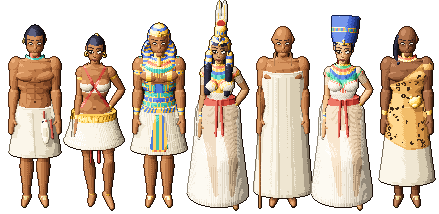
Almost everything was white linen. Flax grew along the Nile, linen was spun and woven at home and in temple workshops, and it took dye badly, so most clothes stayed the colour of bleached flax. Red came from madder, ochre and safflower, blue from indigo, but colour went into belts, borders, beads and collars rather than whole garments.

Rank showed in other ways: in how fine the linen was, in pleats, wigs and jewellery. A farmer worked in a short loincloth; a nobleman at a New Kingdom feast wore pleated linen so fine that his body showed through. Priests wore only linen and papyrus sandals and shaved their heads — Herodotus noted that wool was never taken into a temple (Histories 2.37 and 2.81).

Some things belonged to the king alone: the nemes headcloth, the crowns, the uraeus cobra on the brow, the crook and flail, the bull’s tail at the belt. Queens wore the vulture crown and the horns of Hathor, and only sem priests and high priests wore the leopard skin.

Periods: Old Kingdom about 2686–2181 BC, Middle Kingdom about 2055–1650 BC, New Kingdom about 1550–1069 BC. On textiles and dyes see UCL’s Digital Egypt for Universities; each outfit below names the museum objects it is drawn from.

Ten outfits for men

From the scribe and the desert guard to the Lord of the Two Lands. Each picture is the game’s own character engine: front, side and back. The price is in debens, and the rank is the level from which the outfit can be bought.

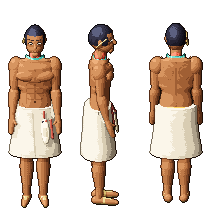
Scribe: A linen wrap kilt to the knee, a reed pen behind the ear, an ink palette and pen case on a cord, papyrus sandals.
Scribe

  • Old Kingdom
  • 500,000 debens
  • any rank

Only a small share of Egyptians could read and write, and a scribe never had to carry bricks or till fields — a school text urges boys to become scribes for exactly that reason. The Seated Scribe in the Louvre (E 3023), painted limestone from Saqqara made around 2500 BC, sits cross-legged in a white kilt with a papyrus open on his lap. On wooden panels in Cairo, Hesy-Ra, chief of scribes under King Djoser, carries his palette and pen case over his shoulder.

In the game: A linen wrap kilt to the knee, a reed pen behind the ear, an ink palette and pen case on a cord, papyrus sandals.
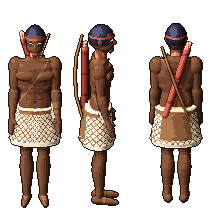
Medjay Desert Guard: A short kilt under a leather mesh loincloth, a bow and quiver on the back, an archer’s bracer, leather sandals.

Medjay Desert Guard

  • Middle and New Kingdom
  • 500,000 debens
  • any rank

The Medjay were a people of the Nubian desert, prized as scouts and archers; in the New Kingdom their name came to mean the desert police who guarded the royal tombs of Thebes. Over a linen loincloth, soldiers and workers wore a leather one slit into a fine net so it would not tear, like EA 2564 in the British Museum, cut from a single hide. Forty Nubian archers in short kilts march in a wooden model from the tomb of Mesehti at Asyut, about 2000 BC, now in Cairo.

In the game: A short kilt under a leather mesh loincloth, a bow and quiver on the back, an archer’s bracer, leather sandals.

Pharaoh’s Charioteer: A cuirass of red leather scales on linen with a bronze edge, a kilt with a stiff striped front, leather driver’s bracers.

Pharaoh’s Charioteer

  • New Kingdom
  • 750,000 debens
  • from rank 16, Charioteer

Chariots reached Egypt around 1600 BC, and in the New Kingdom chariot crews were the elite of the army: a driver held the reins while a warrior shot from the car. Tutankhamun’s tomb held a body armour of leather scales sewn onto linen, and gloves for the reins. The Metropolitan Museum keeps ten bronze armour scales (11.215.452a–j) found in a wall at Malqata, the palace of Amenhotep III.

In the game: A cuirass of red leather scales on linen with a bronze edge, a kilt with a stiff striped front, leather driver’s bracers.

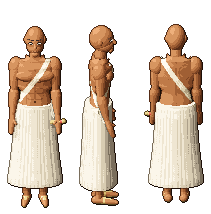
Lector Priest: A long linen kilt, the broad sash across the chest that marks a lector, a papyrus scroll in hand, papyrus sandals.

Lector Priest

  • New Kingdom to Late Period
  • 750,000 debens
  • from rank 27, Lector Priest

The lector priest — kheri-heb, “the one who carries the ritual book” — read hymns and spells aloud at temple rites and funerals, including the Opening of the Mouth. His mark was a broad white sash across the chest. A relief in the Metropolitan Museum attributed to the chief lector Petamenophis (7th century BC) shows a man with exactly this sash; his tomb at Thebes is one of the largest private tombs in Egypt.

In the game: A long linen kilt, the broad sash across the chest that marks a lector, a papyrus scroll in hand, papyrus sandals.
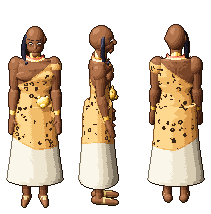
Sem Priest: A leopard skin over the left shoulder with a gilded head, a long linen kilt; on a shaved head, the sidelock of youth.

Sem Priest

  • New Kingdom
  • 1,000,000 debens
  • from rank 29, Sem Priest

The sem priest wore a leopard skin over one shoulder and often the sidelock of youth on a shaved head; his great task was to open the mouth of the dead so that they could eat, breathe and speak in the afterlife. On the wall of Tutankhamun’s burial chamber (KV62) the new king Ay performs this rite for him dressed as a sem priest. The tomb also held a ritual leopard-skin robe with gilded wooden leopard heads, now in Cairo.

In the game: A leopard skin over the left shoulder with a gilded head, a long linen kilt; on a shaved head, the sidelock of youth.

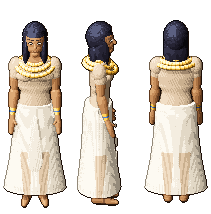
King’s Friend: Gold of Honour: A pleated shirt with sleeves, a long sheer skirt with an apron and the shebyu collar of gold discs — the pharaoh’s reward; with a shoulder-length wig, a double wig.

King’s Friend: Gold of Honour

  • New Kingdom
  • 1,000,000 debens
  • from rank 35, Sole Companion

The highest reward a pharaoh could give was the “gold of praise”: collars of heavy gold disc beads, shebyu, put round the neck in public — in his tomb at Amarna the courtier Ay receives them from Akhenaten at the palace window. Court dress in the New Kingdom meant a pleated shirt with sleeves, a long sheer kilt and a double wig like EA 2560 in the British Museum, made of human hair and found in its own reed box. The pair statue of Yuny and his wife Renenutet in the Metropolitan Museum (15.2.1) shows the whole outfit.

In the game: A pleated shirt with sleeves, a long sheer skirt with an apron and the shebyu collar of gold discs — the pharaoh’s reward; with a shoulder-length wig, a double wig.

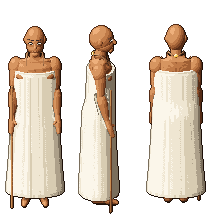
Vizier: A long heavy linen wrapped robe from chest to ankles on a cord around the neck, the vizier’s gold seal, a staff.

Vizier

  • New Kingdom
  • 1,500,000 debens
  • from rank 47, Vizier

The vizier ran the government and judged in the king’s name, and in the New Kingdom he had a costume of his own: a long, stiff white garment wrapped from the chest to the ankles and held up by a cord around the neck. The vizier’s seal hung from that cord — a limestone statuette of a vizier of Akhenaten in the Metropolitan Museum (2007.363) shows its clasp shaped like a cartouche. In the tomb of Rekhmire, vizier of Thutmose III (TT100), the walls carry the text known as the Duties of the Vizier.

In the game: A long heavy linen wrapped robe from chest to ankles on a cord around the neck, the vizier’s gold seal, a staff.

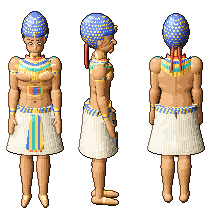
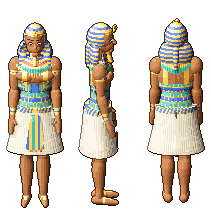
Pharaoh in the Blue Crown: The khepresh with gold discs and a uraeus, the royal pleated kilt with an apron and a bull’s tail, a broad collar, a pectoral, gold sandals.

Pharaoh in the Blue Crown

  • New Kingdom
  • 2,000,000 debens
  • from rank 49, Pharaoh

The blue crown, khepresh, belongs to the New Kingdom: a tall cap, probably of leather or stiffened cloth, dotted with small gold discs and with a uraeus cobra over the brow. Kings wore it in battle and at ceremonies, and Amenhotep III seems to have liked it best of all his crowns. His quartzite head in the Metropolitan Museum (56.138), about 1390–1352 BC, wears exactly this crown.

In the game: The khepresh with gold discs and a uraeus, the royal pleated kilt with an apron and a bull’s tail, a broad collar, a pectoral, gold sandals.

Pharaoh in the Nemes: The striped nemes with a uraeus and vulture, a feathered corselet and scarab pectoral, a kilt with an apron and bull’s tail, gold sandals.

Pharaoh in the Nemes

  • New Kingdom
  • 2,500,000 debens
  • from rank 49, Pharaoh

Only the king wore the nemes, a striped linen headcloth with lappets falling onto the chest, from Djoser in the Old Kingdom on; the best known is on Tutankhamun’s gold mask. His ceremonial corselet in Cairo (JE 62627), of gold with coloured inlays laid out like feathers, was worn with a pectoral over the pleated royal kilt. The two life-size guardian statues that stood at the door of his burial chamber (JE 60707–60708, now in the Grand Egyptian Museum) show the king in the royal kilt with a gilded apron.

In the game: The striped nemes with a uraeus and vulture, a feathered corselet and scarab pectoral, a kilt with an apron and bull’s tail, gold sandals.

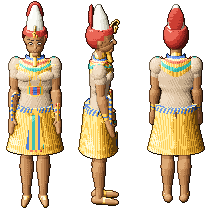
Lord of the Two Lands: The double crown — white of Upper and red of Lower Egypt — the crook and flail, a gilded pleated kilt with an apron and bull’s tail, a fine shirt.

Lord of the Two Lands

  • New Kingdom
  • 3,000,000 debens
  • from rank 50, Chosen of Ra

The double crown, pschent, joined the red crown of Lower Egypt with the white crown of Upper Egypt and stood for the king’s rule over the Two Lands. Not a single real crown has been found — we know them only from statues, reliefs and paintings. The crook and flail, signs of Osiris and of kingship, did survive: Tutankhamun’s pair, banded with gold and blue glass, is in Cairo.

In the game: The double crown — white of Upper and red of Lower Egypt — the crook and flail, a gilded pleated kilt with an apron and bull’s tail, a fine shirt.

Ten outfits for women

From the Old Kingdom lady in a white sheath to the queen in the crown of Hathor. Your own skin tone, build, height and face stay the same in every outfit.

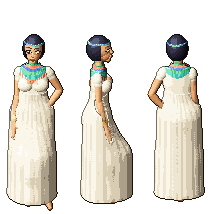
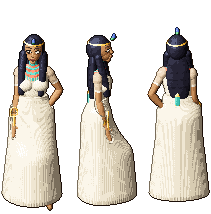
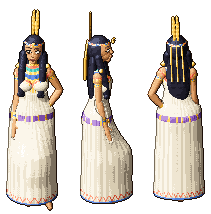
Old Kingdom Lady: A linen close-fitting strapped dress, a mantle on the shoulders, a flower band, a broad collar.

Old Kingdom Lady

  • Old Kingdom
  • 500,000 debens
  • any rank

The painted limestone statues of Prince Rahotep and his wife Nofret from Meidum, about 2600 BC (Cairo CG 3–4), look almost new: even their inlaid eyes still shine. Nofret wears a close-fitting white dress under a white mantle, a heavy wig held by a band of flowers and a broad collar of coloured beads. A tight white sheath on straps was the dress of Old Kingdom ladies; the colour was in the jewellery, not the linen.

In the game: A linen close-fitting strapped dress, a mantle on the shoulders, a flower band, a broad collar.

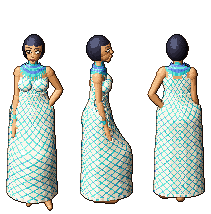
Faience Bead-Net Dress: A diamond net of turquoise and lapis beads over a linen dress, a fringe of shells.

Faience Bead-Net Dress

  • Old Kingdom
  • 500,000 debens
  • any rank

Over a linen dress, Old Kingdom women sometimes wore a net of faience beads in a diamond pattern. The oldest surviving one, from a woman’s burial at Giza in the reign of Khufu, about 2550 BC, is in the Museum of Fine Arts, Boston (27.1548.1): it was put back together from about 7,000 beads that still lay in place around the body. The Petrie Museum in London keeps another bead-net dress, from Qau (UC17743).

In the game: A diamond net of turquoise and lapis beads over a linen dress, a fringe of shells.

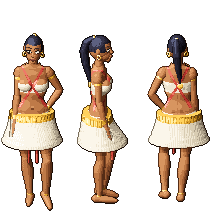
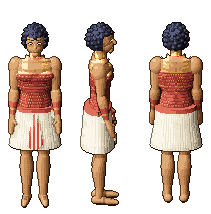
Dancer: A short kilt with long belt ends, a girdle of gold cowrie shells, crossed bands, hoop earrings; on a high ponytail, a weight disc.

Dancer

  • Middle and New Kingdom
  • 500,000 debens
  • any rank

Dancers performed at banquets, festivals and funerals, often in little more than a short skirt, crossed bands and a girdle. A limestone ostracon in the Museo Egizio in Turin (Cat. 7052), from Deir el-Medina, catches a dancer in a deep backbend with her long hair touching the ground. The gold cowrie-shell girdle of Princess Sithathoryunet in the Metropolitan Museum (16.1.5) hides metal pellets in its shells, so it jingled softly with every step.

In the game: A short kilt with long belt ends, a girdle of gold cowrie shells, crossed bands, hoop earrings; on a high ponytail, a weight disc.

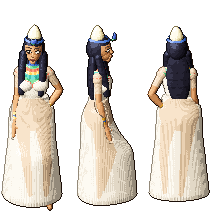
Banquet Guest: A sheer pleated gown, a scent cone on the head, a lotus above the brow, a floral collar.

Banquet Guest

  • New Kingdom
  • 750,000 debens
  • any rank

Paintings of New Kingdom banquets show guests in fine, almost transparent pleated linen, with lotus flowers and a white cone on their wigs. In the feast from the tomb-chapel of Nebamun in the British Museum (EA 37984), about 1370 BC, men and women sit together while musicians play and two dancers perform. For a long time the cones were taken for a painter’s sign of perfume, until in 2019 archaeologists published two real wax cones from graves at Amarna.

In the game: A sheer pleated gown, a scent cone on the head, a lotus above the brow, a floral collar.

Chantress of Amun: A fringed pleated gown with a sheer cape, a menat necklace with its counterpoise on the back, a sistrum in hand, a band with a lotus bud.

Chantress of Amun

  • New Kingdom
  • 750,000 debens
  • from rank 26, Wab Priestess

Chantresses of Amun, shemayet, sang in the temple of Karnak and shook the sistrum and the menat, a heavy bead necklace with a counterpoise that hung down the back. Women of many families held the title, from craftsmen’s wives to princesses. The coffins of Henettawy, a chantress of Amun around 1000 BC, are in the Metropolitan Museum (25.3.182), and so is a menat from Malqata, the palace town of Amenhotep III (11.215.450).

In the game: A fringed pleated gown with a sheer cape, a menat necklace with its counterpoise on the back, a sistrum in hand, a band with a lotus bud.

Wing Dress: A close-fitting dress of rishi feathers — small ones on the bodice, long wing feathers on the skirt — and a gold band.

Wing Dress

  • Middle Kingdom
  • 1,000,000 debens
  • from rank 30, Keeper of Secrets

Goddesses such as Isis, Nephthys and the vulture Nekhbet were shown with wings that enfold and protect, and their dresses carried the same pattern of feathers. The grey siltstone Isis in the British Museum (EA 1162), about 590–530 BC, wraps her wings around Osiris. Much earlier, in the Middle Kingdom, a wooden offering bearer from the tomb of Meketre in the Metropolitan Museum (20.3.7) already wears a dress patterned with feathers.

In the game: A close-fitting dress of rishi feathers — small ones on the bodice, long wing feathers on the skirt — and a gold band.

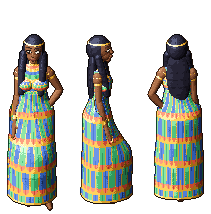
Princess: A gold diadem with rosettes, a uraeus and two plumes, streamers behind; a dress with a patterned hem, an amethyst bead girdle, a collar with falcon heads.

Princess

  • Middle Kingdom
  • 1,500,000 debens
  • from rank 34, King’s Acquaintance

In 1914 archaeologists at Lahun found the jewellery of Princess Sithathoryunet, a daughter of Senusret II, in a niche of her tomb that robbers had missed. Her gold diadem with rosettes, a uraeus and two tall plumes is in Cairo (JE 44919); most of the rest went to the Metropolitan Museum. The broad collar with falcon-head clasps in the same museum belonged to another lady of the 12th Dynasty, Senebtisi (08.200.30).

In the game: A gold diadem with rosettes, a uraeus and two plumes, streamers behind; a dress with a patterned hem, an amethyst bead girdle, a collar with falcon heads.

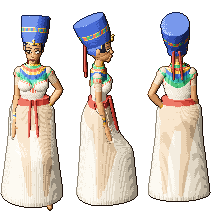
Nefertiti: The flat-topped blue crown with a gold band and uraeus; a pleated gown with a red sash, a floral collar.

Nefertiti

  • Amarna period
  • 2,000,000 debens
  • from rank 48, Heir to the Throne

The tall flat-topped blue crown is Nefertiti’s own: it is known almost only from her images. Her painted bust was found in 1912 in the workshop of the sculptor Thutmose at Amarna and is now in Berlin (ÄM 21300). A red quartzite torso in the Louvre (E 25409), very likely Nefertiti too, shows pleated linen so fine that the body shows through, tied with a sash under the breast.

In the game: The flat-topped blue crown with a gold band and uraeus; a pleated gown with a red sash, a floral collar.

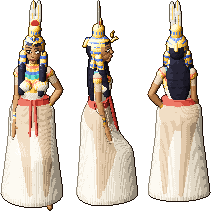
Nefertari: The vulture crown, a modius, two tall plumes and a sun disc; fringed pleats, a red sash, gold sandals.

Nefertari

  • New Kingdom
  • 2,500,000 debens
  • from rank 49, Pharaoh

Nefertari was the great royal wife of Ramesses II, and her tomb in the Valley of the Queens (QV66) holds some of the finest paintings of ancient Egypt. On its walls she wears the vulture crown — the wings of the goddess Nekhbet over the wig — with two tall plumes and a sun disc, a white pleated dress and a red sash. The Metropolitan Museum has a copy of one of these scenes, Nefertari playing senet, painted in the tomb in 1921–1922 (30.4.145).

In the game: The vulture crown, a modius, two tall plumes and a sun disc; fringed pleats, a red sash, gold sandals.

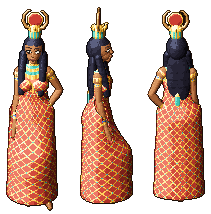
Queen in the Hathor Crown: Cow horns with a sun disc on a modius of uraei, a close-fitting red dress in a gold net, a menat necklace.

Queen in the Hathor Crown

  • New Kingdom
  • 3,000,000 debens
  • from rank 50, Chosen of Ra

Cow horns with a sun disc between them were the crown of Hathor, goddess of love, music and joy, and from the 18th Dynasty queens wore it too, usually with two tall plumes: Tiye, the great royal wife of Amenhotep III, appears in it on reliefs and statues. A red sheath dress under a net of beads is how goddesses are often painted in New Kingdom tombs. Hathor gave her name to our Club, the Feast of Hathor, and has a page of her own.

In the game: Cow horns with a sun disc on a modius of uraei, a close-fitting red dress in a gold net, a menat necklace.

How the Attire tab works

  • Where. Open the Wardrobe in the game and its Attire tab, the fourth one, after Hair. It is a single list from the cheapest to the most expensive: four sets of clothes and jewellery together (Everyday, Craftsman, Feast day and Royal) and the ten museum-based outfits for your character’s sex.
  • One item per row. On the left, a picture; on the right, the name, the price, what it is made of, the artefact behind it, the rank, the fabric colours and a “Buy” or “Wear” button. Tap the picture and the item appears on the large figure in the window: turn it to any side. Trying on costs nothing, even before you reach the rank.
  • Buy once. “Buy” takes the debens after a confirmation, and the item is yours for good. Switching between your outfits and sets is free. If you bought underwear or jewellery separately before, a set costs you less by their price.
  • Fabric colour for free. The linen of the sets and of almost every outfit can be dyed: linen white, gold, cinnabar, turquoise, lapis, obsidian or purple (sets also come in leopard). The Wing Dress and the Queen in the Hathor Crown keep the colours of their artefacts.
  • Rank. Townspeople’s outfits are open to everyone. Army, temple, court and throne outfits open at a rank — until then the row shows a lock and “Opens at rank N”.
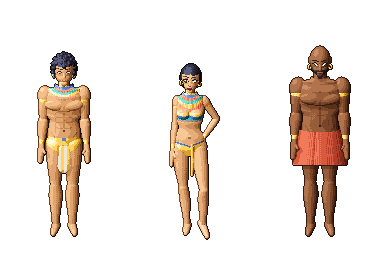
  • What stays yours. Sex, skin tone, build, height, face, beard and hairstyle. The outfit goes on top: a crown or nemes hides your hair beneath it, and a band or diadem sits on your own hair.
  • In the city. Everyone around sees your outfit — when you walk, sit at a table, dance or use any emote.

Who could wear what

In Egypt clothes told people who you were, so in Anubis City the price grows with a person’s place in society and the better outfits wait for a rank. Townspeople’s outfits cost 500,000–750,000 debens and need no rank. Army and temple outfits open at the rank of their trade: the charioteer at Charioteer (16), the chantress at Wab Priestess (26), the lector at Lector Priest (27), the sem priest at Sem Priest (29), the wing dress at Keeper of Secrets (30). Court dress waits for the courtiers’ ranks, from King’s Acquaintance (34) to Vizier (47). The crowns of the pharaoh and the queens cost 2,000,000–3,000,000 debens and open only at the very top: Heir to the Throne (48), Pharaoh (49) and Chosen of Ra (50).

Every rank is a real Egyptian title — see the 50 ranks and the experience each one takes. Debens for the outfits come from the tables, Ra’s Boat and new levels; what a deben was in Egypt is told in the deben.

What we simplified

  • In Egypt crowns belonged to the king and the queens alone, and anyone else putting one on was unthinkable. In the game anyone who reaches the top ranks can wear one.
  • The outfits come from different centuries: the bead-net dress is more than a thousand years older than the blue crown. In the city they all meet on one square.
  • Not a single real Egyptian crown has survived. The double crown, the blue crown and Nefertiti’s crown are drawn from statues, reliefs and paintings.
  • Colours in our pixels are a little brighter than on the faded originals, and fabrics are simplified to what can be drawn at a character’s size.

Questions about Egyptian clothing

What did ordinary Egyptians wear?

Men wore a short linen kilt, the shendyt, or a loincloth; women wore a long straight dress on straps. Many people went barefoot, and sandals of papyrus or leather were a sign of some wealth.

Why was Egyptian clothing white?

Linen is hard to dye, and white linen was a sign of purity. Colour came from beads, collars, belts and borders.

Did pharaohs really wear a false beard?

Yes. The royal beard was tied on with straps behind the ears; even Hatshepsut wears it in her statues as king.

Can I try an outfit on before buying it?

Yes. In the Attire tab of the Wardrobe any outfit can be tried on for free, from any side and in motion, even before you reach its rank.

Do outfits change anything in the games?

No. An outfit only changes how your character looks: cards, the roulette wheel, bingo balls and slot reels do not depend on it.

Read next

Ranks and titles

All 50 ranks of the game: real Egyptian titles, what they meant and how much experience each one needs.

Read more →

The deben

A weight of about 91 grams that worked as money: prices from Deir el-Medina, barter, and the meaning of the ankh.

Read more →

Hathor

The goddess of love, music and dance, crowned with cow’s horns and the sun disc — and the lady of our club.

Read more →

Senet

Play senet online against the computer or a friend, plus its history, the board, the rules and a step-by-step example.

Read more →

Try them on

Open the Wardrobe, choose the Attire tab and see any of the twenty outfits on your own character — trying on is free.

Play free