

Ra
The sun god and creator who crossed the sky by boat — and the lord of our slot hall and the Ra Boat.
Read more →Cow, lady of the sky, the Eye of Ra and the patron of every Egyptian party. How the Egyptians saw her — and why our club carries her name.
Hathor was the Egyptian goddess of the sky, of love and women, of music, dance and joy, and a protector of mothers. She appears as a cow, as a woman with cow’s ears, or as a woman wearing a sun disc between cow’s horns. Her name means “House of Horus”, and her great temple stands at Dendera.
Britannica adds that the name may not be her original one, and that she was closely tied to the sun god Ra, as his daughter or his “eye”. She was also one of the best-loved goddesses in Egypt, worshipped everywhere from the mines of Sinai to the cemeteries of Thebes.
There are three forms to look for. A cow, often with a sun disc between its horns. A woman wearing the horns and disc as a crown. And a face seen from the front, with cow’s ears and a heavy wig curling outwards at the ends — a rare sight, because Egyptian art almost always drew faces in profile. That frontal face tops the columns of her temples: at Dendera it crowns the columns of the great hall.
Her instruments help too. The sistrum, a rattle with jingling metal bars, belonged above all to her. The Met has one carved in Egyptian alabaster about 4,300 years ago, inscribed for King Teti and dedicated to “Hathor, Lady of Dendera”; the museum notes that its sound was meant to calm dangerous deities, Hathor in particular. Another clue is the menat, a heavy bead necklace with a counterweight that her priestesses shook like a rattle.
Be careful with Isis. From the New Kingdom on, Isis also wears the horns and the disc, and the two can be hard to tell apart. Read the label if there is one: Hathor’s name is written as a falcon inside a house — literally “House of Horus” — while Isis’s name begins with a throne.
In the Book of the Heavenly Cow, a text found on one of Tutankhamun’s gilded shrines and in the tomb of Seti I, Ra has grown old and people plot against him. The gods advise him to send out his Eye. The Eye goes out as Hathor and begins to kill; in her fury she becomes Sekhmet, “the Powerful One”. Ra changes his mind but cannot call her off. So he has seven thousand jars of beer brewed, coloured red with ochre and poured over the fields at night. In the morning she sees the “blood”, drinks, grows drunk and forgets the slaughter. Mankind survives.
How far Hathor and Sekhmet are one goddess depends on the source. Britannica treats Sekhmet as a war goddess of her own, worshipped at Memphis, called the Eye of Ra like other fierce goddesses and sometimes identified with Hathor.
In another myth the Eye of Ra quarrels with her father and leaves for the southern deserts as a raging lioness. A messenger — Thoth in one version, Shu or Onuris in others — talks her into coming home. When she returns she is gentle again, and Egypt celebrates.
The tale of Horus and Seth, preserved on a papyrus in the Chester Beatty Library in Dublin, has a scene that surprises modern readers. Ra is insulted at the trial, walks off and lies down to sulk. Hathor comes to him and lifts her dress; the great god laughs, gets up and goes back to judging. In the same tale she heals the eyes of Horus with gazelle milk.
Folk tales know Hathor in seven forms who come to a newborn child and announce its fate. In the Tale of the Doomed Prince, written on a papyrus now in the British Museum, the Seven Hathors foretell that the prince will die by a crocodile, a snake or a dog.
Dendera was her city. The temple standing there today was built under the Ptolemies and finished under the Roman emperor Tiberius, on foundations that go back at least to the time of Khufu, and it is one of the best preserved in Egypt. A ceiling from one of its rooftop chapels, the Dendera zodiac, was taken to France in the 1820s and is now in the Louvre.
Every year her statue sailed up the Nile from Dendera to Edfu to visit Horus in his temple. In the Theban necropolis she was the “Lady of the West”, who received the dead, and Queen Hatshepsut gave her a chapel in her temple at Deir el-Bahari. In the Sinai turquoise mines she was the “Lady of Turquoise”, and as the patroness of foreign lands she was worshipped well beyond Egypt.
Hathor was the goddess people turned to for love, for children and for a safe birth. She was the lady of music and of drink, and her festivals were loud. Excavating the temple of Mut at Karnak, Betsy Bryan of Johns Hopkins University found evidence of a “porch of drunkenness” from Hatshepsut’s reign and studied the Festival of Drunkenness, which re-enacted the myth of the red beer (NBC News, 2006).
Banquets with music and wine belonged to her world, and tomb paintings give the best picture of them. On a fragment from the tomb of Nebamun in the British Museum, two of the musicians look straight out at you, which is very unusual in Egyptian art.
In the afterlife she welcomed the dead. Britannica notes that in the Late Period women hoped to become one with Hathor in the next world, as men hoped to become Osiris. The Greeks, when they met her, saw their own Aphrodite.
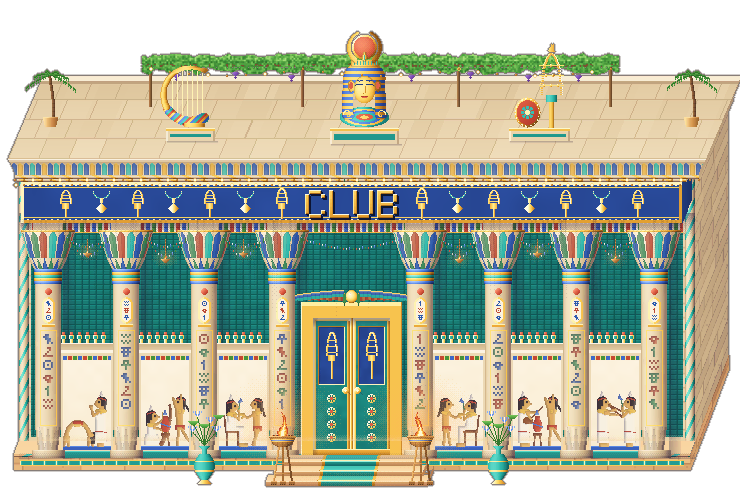
Hathor has the liveliest building in the city: the Club, called the Feast of Hathor. It stands on the left side of the square, between the Palace on the Nile and the Hall of Seshat, and faces the great sphinx across the plaza. Its wide colonnade has eight papyrus columns painted with cartouches and hieroglyphs, and between them run banquet scenes like those in the tombs of Thebes: a harpist, musicians with a lute and a double flute, dancers, an acrobat bending into a bridge, guests with lotuses and servants with jars of wine. Behind them glows a wall of turquoise faience — a bow to the Lady of Turquoise.
The sign is gold on lapis, hung with sistrums and menat necklaces; braziers burn by the steps, and golden doors with sistrums close the entrance. On the roof, under a vine pergola strung with lights, stands a golden head of Hathor with cow’s ears, a striped wig and a carnelian sun disc between her horns. To her left is a great arched harp, to her right a sistrum with Bastet the cat on top and a frame drum.
The Club is open: inside is her night festival, with a bar of red beer under a painting of Sekhmet drinking, columns with the face of Hathor as at Dendera, a harpist on a dais and a dance circle called “the sun of Hathor”. All about it is on the Feast of Hathor page. You can also send a friend a gift wrapped as a sistrum, “the rattle of the goddess Hathor”, and remember our 31st rank, God’s Servant: noblewomen often served Hathor as priestesses. More in the city guide.
Her main animal form was the cow, and she is often shown with cow’s horns or ears. But she was much more than that: a sky goddess, the lady of love, music and dance, and a protector of women.
From the New Kingdom on, both wear cow’s horns and a sun disc. Look at the name: Hathor’s is written as a falcon inside a house, Isis’s begins with a throne. A frontal face with cow’s ears is always Hathor.
Not quite. In the myth of the red beer Hathor turns into the raging Sekhmet, but elsewhere Sekhmet is a lion goddess of Memphis in her own right. Both were called the Eye of Ra.
At Edfu she was his consort, and her statue sailed there from Dendera every year. Other texts make her his mother — her very name means “House of Horus”.
Because she was the Egyptian goddess of music, dance and feasting. Her golden head stands on the roof of the Club, between a harp and a sistrum, and inside the hall celebrates her night festival with red beer and dancing.
The sun god and creator who crossed the sky by boat — and the lord of our slot hall and the Ra Boat.
Read more →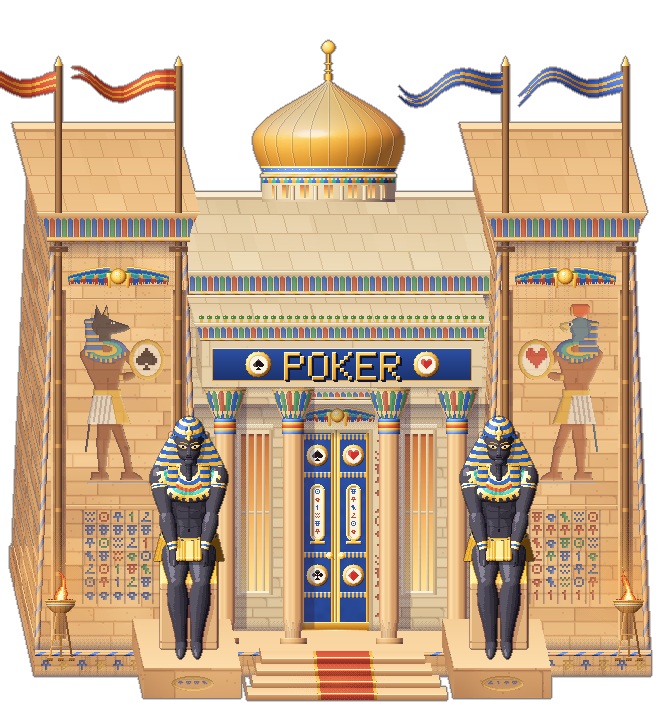
The falcon god of the sky and of kingship, owner of the famous eye — and the god on the pylon of our poker temple.
Read more →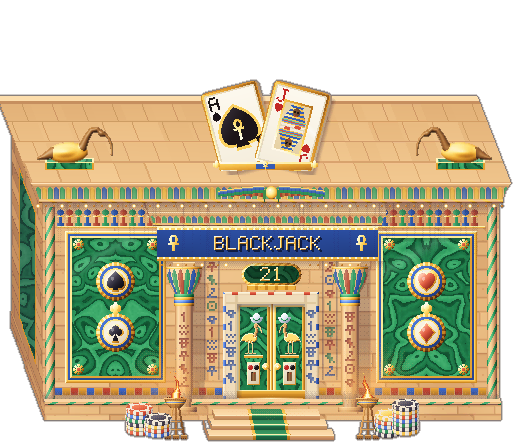
The ibis-headed scribe of the gods, lord of the moon and of reckoning — and the god of our blackjack hall.
Read more →
All 50 ranks of the game: real Egyptian titles, what they meant and how much experience each one needs.
Read more →The colonnade with the golden Hathor on its roof stands on the left side of the square. Step inside, dance in the circle and meet people at the bar.
Play free