

Horus
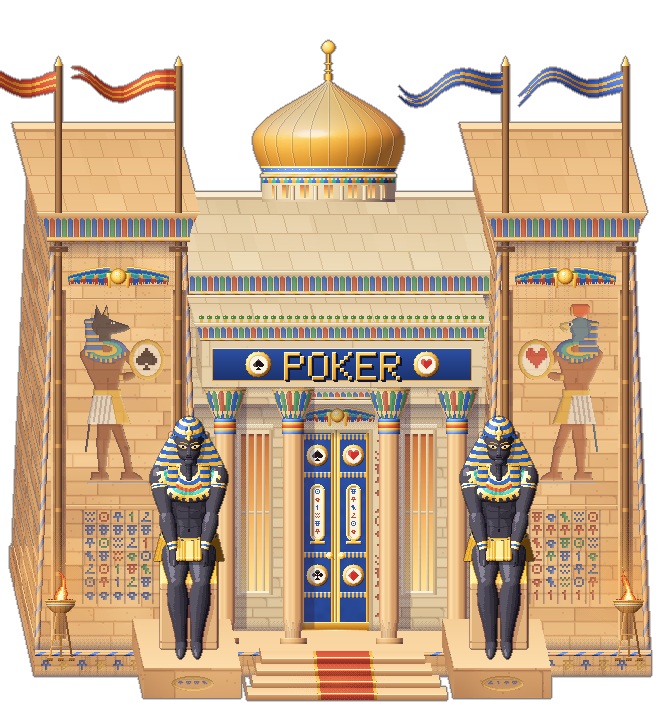
The falcon god of the sky and of kingship, owner of the famous eye — and the god on the pylon of our poker temple.
Read more →Creator, king of the gods and father of the pharaohs. And in Anubis City, the name over the slot hall and the golden boat at the quay.
Ra (Egyptologists often write Re) was the Egyptian sun god and a creator god. By day he crossed the sky in a boat; by night he sailed through the underworld, fought the serpent Apophis and was born again at dawn. His city was Heliopolis, and from the 4th dynasty every pharaoh called himself “Son of Ra”.
For most of Egyptian history he stood at the top. Other gods borrowed his power along with his name — Amun became Amun-Ra, the crocodile god Sobek became Sobek-Ra — and Britannica calls him the father of Maat, the source of right and order in the world.
His most common form is a man with a falcon’s head, crowned with a sun disc encircled by a cobra. In this shape he is often called Ra-Horakhty, “Ra, Horus of the Horizon”, and he is easy to mistake for Horus. A rule of thumb: a falcon head with a sun disc and cobra is Ra; Horus as king usually wears the double crown of Upper and Lower Egypt. The Met’s painted stela of Aafenmut, about 2,900 years old, shows a man making offerings to the falcon-headed sun god in exactly this form.
The sun also changed shape through the day. Britannica describes the old creator Atum as the setting sun, who had to be renewed during the night to appear as Khepri at dawn and as Ra at noon. Khepri is the scarab beetle, rolling the sun up into the sky the way a dung beetle rolls its ball. In the night boat Ra is often shown with the head of a ram.
And sometimes Ra is simply the disc: a red or gold circle, often with a cobra hanging from it, above a door, on a boat or on another god’s head.
Heliopolis taught that before anything existed there was only Nun, the dark water of chaos. The creator rose from it onto the first hill of land, made himself and then the other gods — eight of them, says Britannica, who together with him form the Ennead, the Nine of Heliopolis. In this story the creator is Atum or Ra-Atum, and Egyptian priests did not mind the overlap.
One account of where humans came from rests on a pun. In Egyptian, “people” (remet) sounds like “tears” (remyt), and in a Middle Kingdom spell the creator says that he made the gods from his sweat and people from the tears of his eye.
Every day Ra sailed the sky in his day boat; at sunset he changed to the night boat and entered the underworld for the twelve hours of the night. At one of those hours the serpent Apophis attacked. According to Britannica, it was Seth, riding at the prow as Ra’s guardian, who speared the snake — the same Seth who murdered Osiris. Apophis could never be destroyed for good, so the fight came back every night, and the king and his priests performed rites to help Ra win.
Ra did not stay young. In the Book of the Heavenly Cow his bones are silver, his flesh gold and his hair lapis lazuli, and people begin to plot against the ageing king. That leads to the story of his Eye, Hathor, and the red beer. Afterwards, tired of the world, Ra withdraws to the sky on the back of the sky goddess Nut in the form of a cow.
Another story, written on a Ramesside papyrus now in Turin as a spell against snakebite, has Isis shape a snake from earth and Ra’s own spittle. It bites the old god, and nobody can heal him. Isis offers a cure if he tells her his secret name; at last he does, and she gains power over him. The spell was then recited over real snakebite victims: as Ra was healed, so would they be.
Heliopolis, Egyptian Iunu (the On of the Bible), lay where north-eastern Cairo is today. It was a religious centre more than a political one, and in the New Kingdom its temple of Ra was second in size only to Amun’s at Thebes. Under the 5th dynasty the worship of Ra became the cult of the state, and kings of that dynasty built special sun temples with a massive obelisk under the open sky.
Little of Heliopolis survives. The obelisk of Senusret I still stands there and is the oldest obelisk in existence. Two others raised there by Thutmose III travelled much further: they are the “Cleopatra’s Needles” on the Thames Embankment in London and in Central Park in New York.
Thebes, too, joined the sun to its own god: Amun-Ra was the king of the gods for more than a thousand years. Under Akhenaten worship narrowed to the sun disc itself, the Aten — a radical simplification of the sun cult, in Britannica’s words, and one that did not outlive him.
Ra was above all the god of kings. From the 4th dynasty the pharaoh was “Son of Ra”, and Ra entered the throne names kings took at their coronation. Some of the most famous names carry him: Khafre, who built the second pyramid at Giza, and Ramesses, “Ra is the one who bore him”.
Ordinary Egyptians met the sun god in amulets. The scarab of Khepri was one of the commonest charms in Egypt, and it went into the grave so that the dead would be reborn like the morning sun. In the afterlife the dead hoped to ride in Ra’s boat, and in the New Kingdom the royal tomb texts joined Ra with Osiris, lord of the dead, so that every night the sun passed through death and came back.
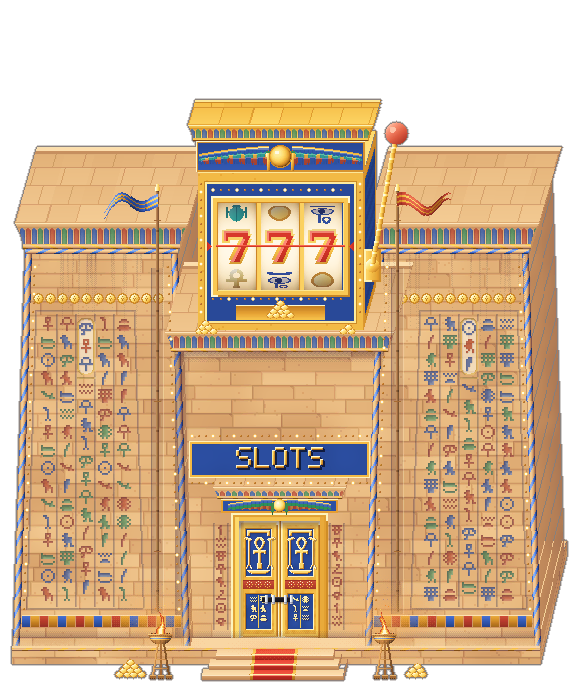
Ra owns the hall of slot machines: the Treasury of Ra, in the back row by the Nile, to the left of the alley of obelisks. Its two sandstone pylons are covered from top to bottom with painted hieroglyphs and royal cartouches. Between them stands a golden shrine built like a slot machine, with three 7s on its reels, a winged sun above them and a lever with a carnelian ball.
Inside are three machines. In Sevens of Ra the wild symbol is the Sun of Ra: it doubles a line win, two suns multiply it by four, and three suns pay 200 bets. The other two are the Book of Thoth and Treasures of Horus. Every spin is drawn on the server, and over a long run each machine returns about 95% of all bets — we checked that over 100 million simulated spins. It is a game for fun with free debens, and no system changes those odds.
His boat is the most useful thing in town. The Ra Boat, a golden barque with a papyrus-shaped prow and stern and a shrine carrying the sun disc, moors at the quay. When it is in, a golden button lights up at the top of the screen: press it and the boat unloads free debens into your purse — 5,000 at level 1 and 250 more for every level after that, plus a little experience. Then it sails away and comes back in ten minutes. More on the rewards page.
Ra turns up in other places too:
Both. Egyptian writing did not record vowels, so the exact sound is unknown. Egyptologists usually write Re, popular books Ra.
No, but the two merged. As Ra-Horakhty, “Ra, Horus of the Horizon”, the sun god took on Horus’s falcon head. Britannica notes that most early solar gods had the form of a falcon.
The serpent Apophis, the force of chaos, who attacked his boat every night in the underworld. He could be beaten but never destroyed, so the fight went on for ever.
It depends on the version. In the Heliopolis story the creator’s first children are Shu and Tefnut, air and moisture. Hathor and other fierce goddesses are called his daughter or his Eye, and Maat, truth and order, is his daughter too.
A golden sun boat that moors at the city quay every ten minutes. Press the golden button at the top of the screen and it brings you free debens — the higher your level, the more.
The falcon god of the sky and of kingship, owner of the famous eye — and the god on the pylon of our poker temple.
Read more →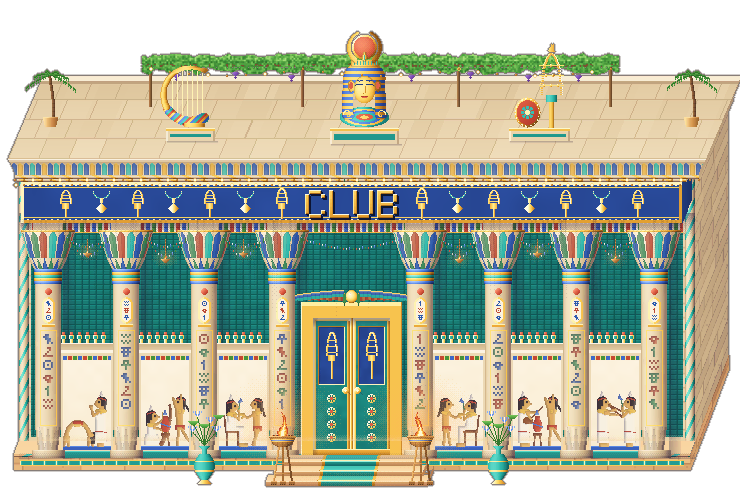
The goddess of love, music and dance, crowned with cow’s horns and the sun disc — and the lady of our club.
Read more →
A weight of about 91 grams that worked as money: prices from Deir el-Medina, barter, and the meaning of the ankh.
Read more →
All 50 ranks of the game: real Egyptian titles, what they meant and how much experience each one needs.
Read more →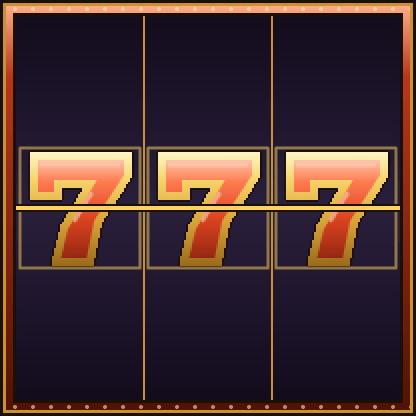
The classic 3-reel machine: paytable, lines, the wild Sun and an exact 95.36% return.
Read more →Open the game and look at the top of the screen: if the golden button is lit, the boat is in. Then walk over to the Treasury of Ra by the Nile.
Play free