

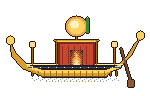
Ra
The sun god and creator who crossed the sky by boat — and the lord of our slot hall and the Ra Boat.
Read more →Son of Isis and Osiris, rival of Seth and the god every pharaoh claimed to be. The myths, the famous eye — and the falcon on our temple.
Horus (Egyptian Hor) was a sky god in the form of a falcon and the god of kingship. In the Osiris myth he is the son of Isis and Osiris who defeated his uncle Seth and took the throne of Egypt, and every living pharaoh was seen as Horus on earth. His right eye was the sun, his left the moon.
He is one of the oldest gods we know: Britannica notes that falcon cults existed before the first dynasty. Over three thousand years he split into many local forms, and some of them had little to do with one another.
Look for a falcon, or a man with a falcon’s head. As king of Egypt, Horus usually wears the double crown: the white crown of Upper Egypt set inside the red crown of Lower Egypt. A dark stripe often runs down his cheek from the eye, like the marking of a real falcon, and the same stripe hangs from the Eye of Horus amulet.
The falcon also appears as the king’s protector. In Cairo, the famous stone statue of Khafre has a falcon perched behind the king’s head, wrapping it in its wings. The Met has a later take on the same idea: a great stone falcon standing over a small figure of King Nectanebo II, carved in the 4th century BC.
Horus the Child, Harpocrates, looks quite different: a naked boy with a sidelock of hair and a finger to his lips, often on his mother’s lap. On magical healing stelae he stands on crocodiles and grips snakes and scorpions; the Met’s Magical Stela with Horus the Child, made under Nectanebo II, is covered with spells against bites and stings.
And sometimes Horus is not a bird at all but a winged sun disc spread over a doorway. Britannica explains it as Horus of Behdet; at Edfu he was Horus of the Winged Disk, the Behdetite.
Egyptian texts know several Horuses. Britannica lists Harmakhis (“Horus in the Horizon”), Harpocrates (“Horus the Child”), Harsiesis (“Horus, Son of Isis”), Harakhte (“Horus of the Horizon”, close to Ra) and Haroeris (“Horus the Elder”), worshipped at Kom Ombo. In Plutarch, Horus the Elder is even born on one of the five extra days that Thoth won from the Moon — as a brother of Osiris rather than his son. Several falcon gods seem to have merged under one name.
After Seth killed Osiris, Isis hid her baby in the papyrus thickets of the Delta. There young Horus was bitten by snakes and stung by scorpions, and his mother healed him with her magic, which is why Horus the Child became the patron of healing spells.
The fullest version of the struggle is a story preserved on a papyrus in the Chester Beatty Library in Dublin. Horus and Seth argue over the throne before the gods for eighty years. They hold contests: they turn into hippopotamuses and stay under water; they race boats of stone — Horus cheats with a wooden boat plastered to look like stone, and Seth’s real stone boat sinks. Seth tears out Horus’s eyes, and Hathor heals them with gazelle milk. In the end a letter from Osiris in the underworld settles the case: Horus becomes king, and Seth goes to live with Ra and thunder in the sky.
Other sources tell the eye story differently. Britannica’s article on Horus says his damaged left eye, the moon, was healed by Thoth, which explained the phases of the moon; its article on the Eye of Horus gives the healing to Hathor. Older still, from the 1st dynasty on, is the idea of Horus and Seth as two rival lords of Egypt reconciled in one kingdom.
His greatest temple stands at Edfu, between Luxor and Aswan. It is 138 metres long; Ptolemy III began it in 237 BC and it was finished in 57 BC, and its simple plan along one axis makes it the classic example of an Egyptian temple. Every year Hathor’s statue came here by boat from Dendera. Britannica adds that a ritual drama was staged at Edfu in which Horus, as pharaoh, spears Seth in the form of a hippopotamus.
Not far away, at Nekhen (the Greeks’ Hierakonpolis, “City of the Falcon”), the idea arose that the reigning king was Horus on earth; when kings from Nekhen united Egypt, it became accepted teaching for the rest of Egyptian history. At Kom Ombo, Horus the Elder shared a double temple with the crocodile god Sobek.
Every pharaoh was Horus. The king’s first and most important name was his Horus name, written inside a serekh — a rectangle showing a palace front with a falcon perched on top. Some of the earliest kings are known to us only by these names.
For ordinary people Horus meant protection. The Eye of Horus, the wedjat or “sound one”, was one of the most popular amulets in Egypt, worn by the living and wrapped into mummies for health and healing. Small magical stelae of Horus the Child stood in homes and temples, and water poured over their spells was believed to cure bites and stings.
In the afterlife Horus is the son who stands up for his dead father. In the Papyrus of Ani, once the heart has been weighed, it is Horus who leads Ani by the hand to Osiris. A living king was Horus; a dead one became Osiris.
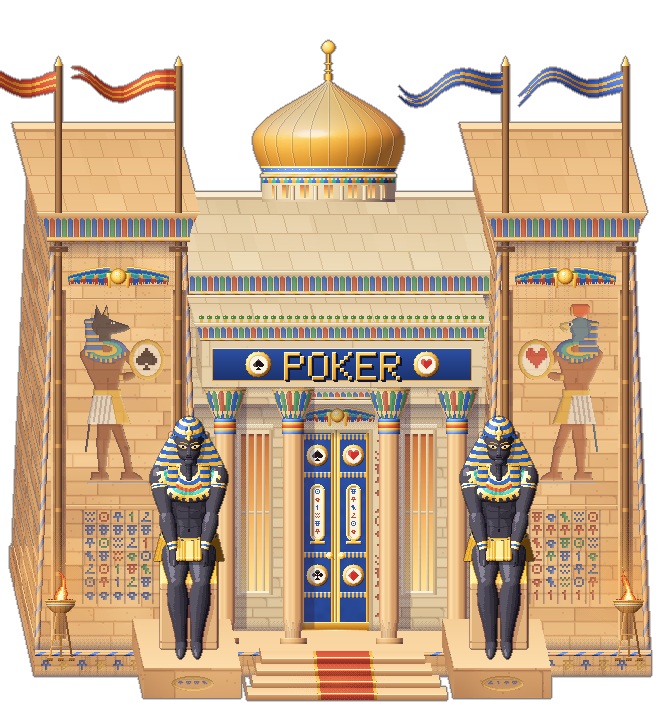
Start at the Temple of Fortune, where Texas Hold’em is played, in the back row by the Nile. On its right pylon a sunk relief shows a falcon-headed god crowned with a sun disc and a cobra, holding a heart in a golden ring, while Anubis faces him from the left pylon with a spade. Strictly speaking, a falcon with a sun disc is how the Egyptians drew Ra-Horakhty, “Ra, Horus of the Horizon” — Horus and Ra in one.
Above each relief spreads a winged sun disc, the emblem of Horus of Behdet. Once you know it, you will see it all over the city: above the reels of the golden machine on the Treasury of Ra, and on the front of the Rotunda of Shai, where a winged sun holds a roulette wheel that really turns.
Inside the Treasury of Ra stands the Treasures of Horus slot machine. Horus himself is the wild symbol and lands on the three middle reels; the other symbols include the Eye of Horus, the cobra, the lotus and the ankh. Golden scarabs carry prizes, six of them start Hold & Win, and four fixed jackpots go up to GRAND — 1,000 bets.
The great sphinx on the right side of the square, between the Rotunda of Shai and the Hall of Thoth, recalls Harmakhis. And the studio that builds Anubis City is called HorusGames.
All of them. Horus is the Greek form of a name the Egyptians pronounced something like Hor; books also use Har, Her and Heru.
Protection, health and restoration. It is the eye Horus lost in his fight with Seth and got back whole, so the amulet was meant to keep its wearer whole as well.
In the best-known version, Isis and Osiris. But Horus the Elder, an older form, appears in Plutarch as a brother of Osiris and a son of the sky goddess Nut.
In the Osiris myth, his uncle: Seth was Osiris’s brother. In the older pairing of Horus the Elder and Seth, the two are brothers.
No, but they merged as Ra-Horakhty, “Ra, Horus of the Horizon”, a falcon-headed sun god. A falcon with a sun disc is usually that combined god; Horus alone more often wears the double crown.
The sun god and creator who crossed the sky by boat — and the lord of our slot hall and the Ra Boat.
Read more →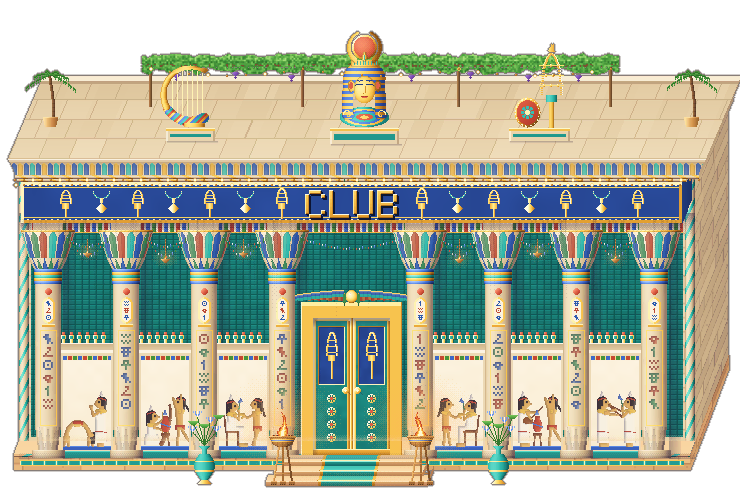
The goddess of love, music and dance, crowned with cow’s horns and the sun disc — and the lady of our club.
Read more →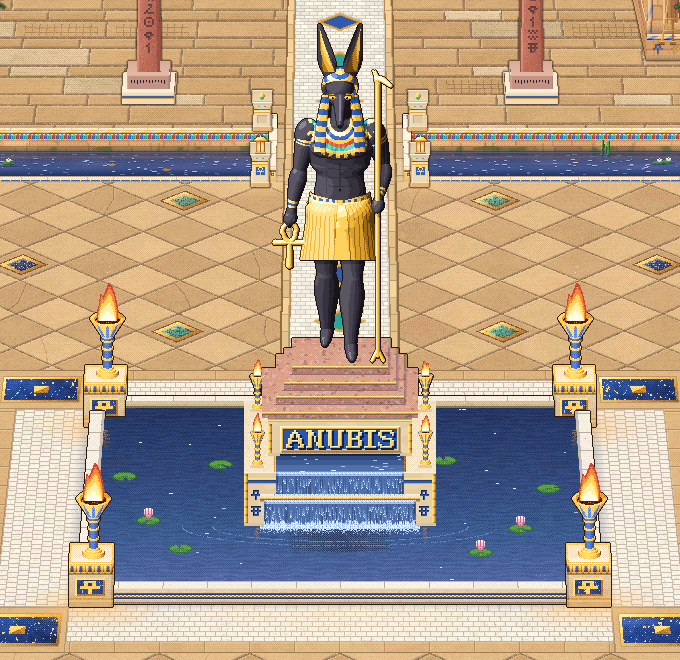
The jackal god of embalming and cemeteries — and the guardian whose statue stands in the middle of our square.
Read more →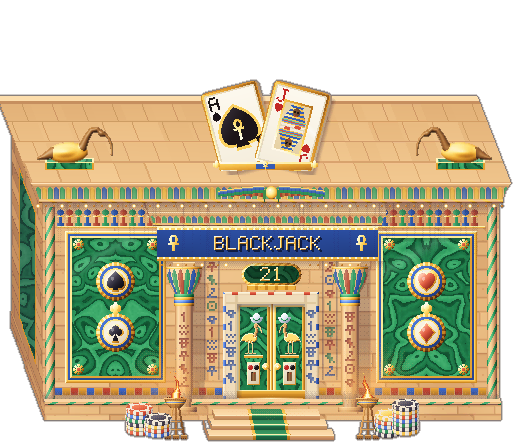
The ibis-headed scribe of the gods, lord of the moon and of reckoning — and the god of our blackjack hall.
Read more →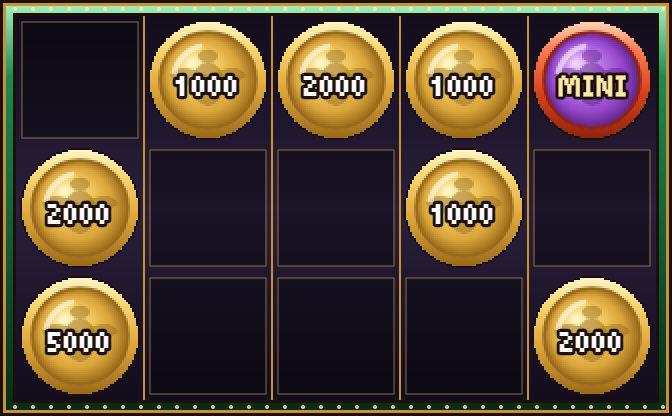
The Hold & Win machine: paytable, scarab prizes, jackpots and an exact 95.14% return.
Read more →Walk to the temple with the golden dome by the Nile and look up at its right pylon. Then try Treasures of Horus in the Treasury of Ra.
Play free