

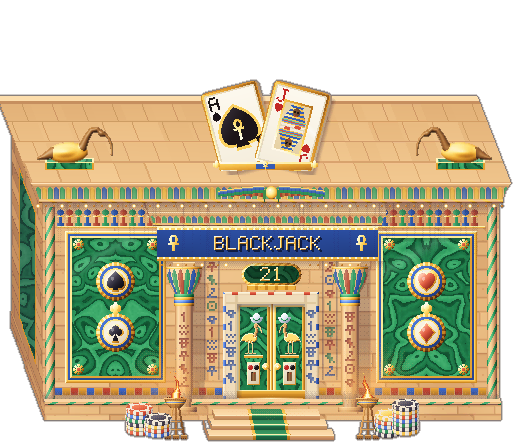
Thoth
The ibis-headed scribe of the gods, lord of the moon and of reckoning — and the god of our blackjack hall.
Read more →How to spot him on a museum wall, what the Egyptians actually believed about him, and why our city carries his name.
Anubis (Egyptian Inpu) was the god of embalming and the guardian of cemeteries, shown as a black jackal or a man with a jackal’s head. In the earliest periods he was the chief lord of the dead. Later Osiris took that title, and Anubis became the god who prepared the body, protected the tomb and led the dead to judgment.
He was never a god of death in the sense of a killer. His work was care. The Egyptians trusted him with the thing they were most afraid to lose: the body they would need in the next life.
His titles, as Britannica lists them, say the same: “He Who Is upon His Mountain” (the mountain is the desert cemetery) and “He Who Is in the Place of Embalming”.
In a museum he comes in two forms. The first is a black canine lying on a chest or shrine, ears up, front paws stretched out. The finest is Tutankhamun’s: Howard Carter found it on a gilded shrine with carrying poles, draped in linen, at the entrance to the room the excavators called the Treasury. It is catalogued in Cairo’s Egyptian Museum as JE 61444.
The second is a man with a jackal’s head, usually in a short kilt. On funerary papyri he bends over a mummy on a lion-shaped bed or kneels beside the scales. In the Papyrus of Ani in the British Museum he checks the plumb line of the balance, while ibis-headed Thoth waits with his palette to write down the result.
Two clues help. Anubis is black, although real jackals are sandy brown: black was the colour of the fertile Nile mud and of new life, and of a body treated with resin. And a canine standing on a pole, often painted grey or white, is more likely Wepwawet, the “Opener of the Ways” — a different god.
The Met in New York has a stranger object of his, the imiut: a headless animal skin hanging from a pole that stands in a pot. Their example is about 3,900 years old, carved in Egyptian alabaster with a pole of cedar.
The best-known story belongs to the myth of Osiris. Seth killed his brother, and the gods had to save the body. Anubis embalmed Osiris, who became the first mummy. Every embalmer after him repeated the god’s work, and in the rites a priest could play Anubis himself.
Here the sources really disagree. The version repeated in most books — son of Osiris and Nephthys — comes from Plutarch, a Greek writer of around AD 100. In his telling Nephthys abandons the baby, Isis finds it with the help of dogs and brings it up, and the boy becomes her guard, protecting the gods “just as dogs protect men”. Older Egyptian texts name other parents and do not agree with each other.
In the Book of the Dead the heart of the deceased is weighed against the feather of Maat, the goddess of truth and order. Anubis tends the balance, Thoth records the verdict, and the monster Ammit waits to swallow a heart that fails. Anubis is not the judge — that is Osiris and his court. He is the one who makes sure the scales are honest.
A late papyrus about the myths of Anubis’s home region, the Jumilhac Papyrus in the Louvre, makes him a fierce bodyguard. Seth, in the shape of a panther, tries to get at the body of Osiris; Anubis catches him and brands his hide, which, the story says, is why the panther has spots. The text is Ptolemaic, written down more than two thousand years after the first images of Anubis.
Anubis never had a temple on the scale of Ra’s at Heliopolis. His own cult town lay in Middle Egypt; the Greeks called it Cynopolis, “dog city”. In a sense, though, every cemetery was his — he was the god “upon his mountain”.
The most striking site is Saqqara, the necropolis of Memphis. In the Catacombs of Anubis, a team led by Paul Nicholson estimated about eight million mummified animals, most of them dogs, buried as offerings to the god in the first millennium BC.
At Deir el-Bahari, in the mortuary temple of Queen Hatshepsut, Anubis has a chapel of his own, and its painted reliefs still keep much of their colour.
For an ordinary Egyptian, Anubis was the god of the funeral. In the Old Kingdom almost every tomb inscription began with the same prayer: “An offering which the king gives, and Anubis…” — the god was asked to give the dead bread, beer and a good burial. Later Osiris joined him in the formula, but Anubis never left it.
Embalming took weeks — Herodotus speaks of seventy days — and Anubis was there throughout. At the end came the Opening of the Mouth, a rite that gave the mummy back the power to eat, speak and see. On the papyrus of the royal scribe Hunefer in the British Museum, Anubis holds the mummy upright at the tomb door while the priests perform it.
After the burial he led the dead into the hall of judgment. As a guide of souls he reminded the Greeks of their Hermes, and in Greco-Roman Egypt the two merged into one god, Hermanubis.
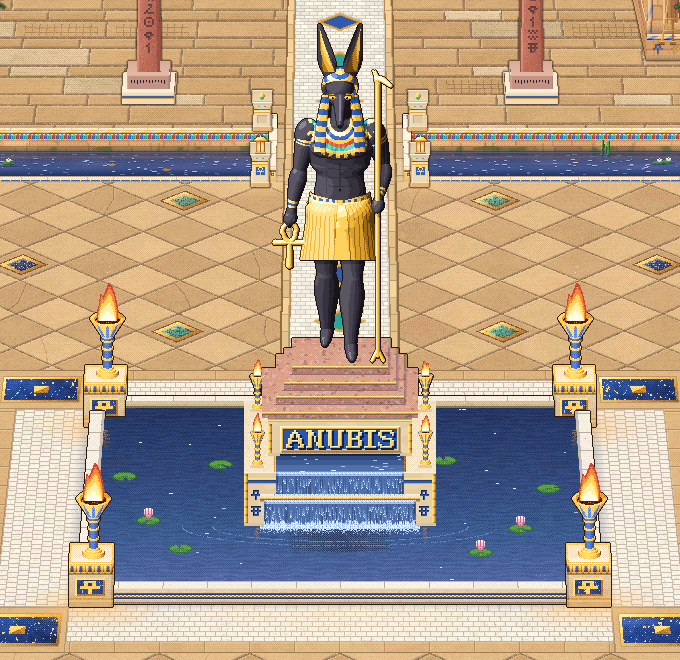
The whole city bears his name, and he meets you at the door: when you open the game, you appear on the square right in front of his statue. Anubis the Guardian stands above the fountain in mid-stride, a was-sceptre before him and an ankh in his lowered hand. A cascade runs from his pedestal into the basin, four lotus torches burn at the corners, and his name glows in gold on a lapis plaque. Walk behind him and the statue turns see-through, so you never lose sight of your character.
The sceptre and the ankh are a pair the Egyptians gave their gods again and again: the was stood for power, the ankh for life.
You will find him in other places too:
More about the square and the fountain is in the city guide.
No. In Egyptian belief he protected the dead: he embalmed bodies, guarded tombs and kept the scales of judgment honest. The sinister Anubis of films and games is a modern invention.
He is a god of the dead rather than of death. He did not make anyone die; he looked after people once they had. In the Old Kingdom he was the main lord of the dead, a role Osiris later took over.
Not because jackals are black — they are sandy brown. Black was the colour of the fertile Nile silt and of rebirth, and also of a mummified body treated with resin.
The sources differ. Plutarch, writing around AD 100, makes him the son of Osiris and Nephthys; older Egyptian texts name other parents and disagree with one another.
He tended the scales and checked that they were true. The verdict was written down by Thoth, and the court was led by Osiris.
The ibis-headed scribe of the gods, lord of the moon and of reckoning — and the god of our blackjack hall.
Read more →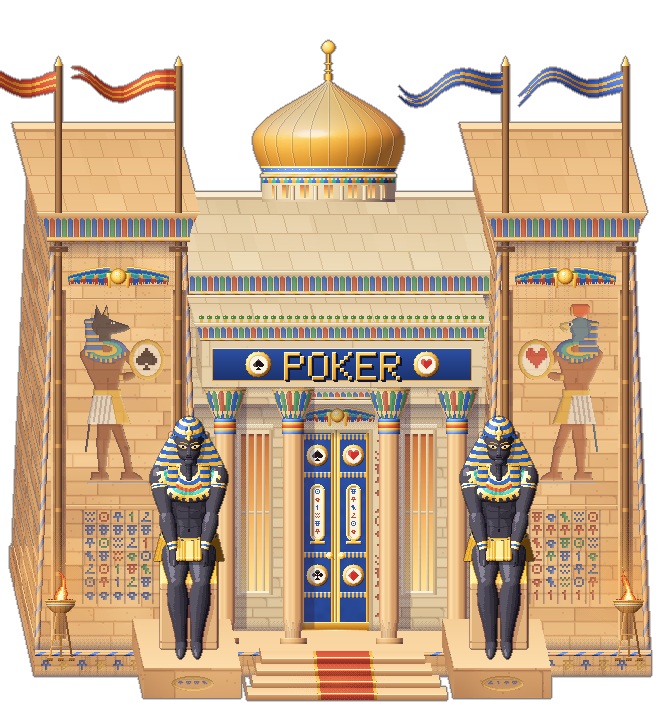
The falcon god of the sky and of kingship, owner of the famous eye — and the god on the pylon of our poker temple.
Read more →
The sun god and creator who crossed the sky by boat — and the lord of our slot hall and the Ra Boat.
Read more →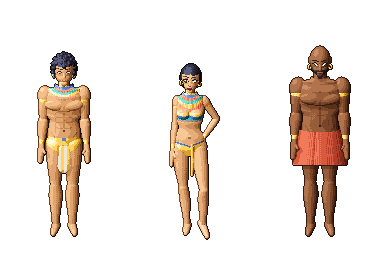
All 50 ranks of the game: real Egyptian titles, what they meant and how much experience each one needs.
Read more →Open the game and you appear on the square right in front of his statue. Walk round the fountain, then over to the balustrade at the edge of the square: below it, the jackal heads pour water into the harbour.
Play free