

How to play
Rules of 75-ball bingo, auto and manual halls, and an example game ball by ball.
Read more →Real 75-ball cards for a bingo night at home, in class or at a party. Choose how many, press Print — nothing to install and nothing to sign up for.
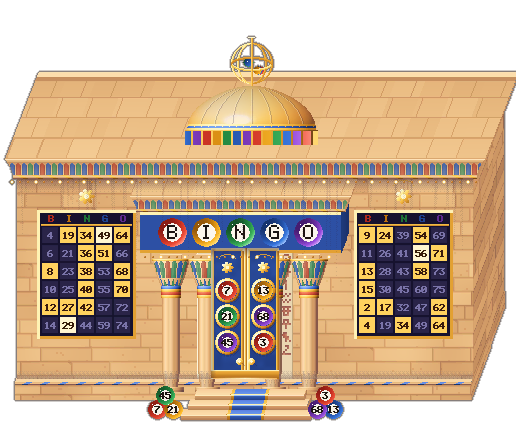
Set the number of cards, choose how many go on a page and press Print. The generator deals proper 75-ball cards — B 1–15, I 16–30, N 31–45 with a free centre, G 46–60, O 61–75 — with no number repeated on a card and no two cards alike. Only the cards go to the printer, in plain black and white.
Each visit deals a new set, and “New numbers” deals another. The cards are numbered, so when someone shouts you can say “card 12, read me your numbers” and check them against the slips you have called.
Every page fits both A4 and US Letter with 10 mm margins. In the print window turn off headers and footers and keep the scale at 100%. If you want to use the cards again, slide them into clear plastic sleeves and mark them with a whiteboard pen.
Pace: about 5 seconds between numbers suits adults; give 8 to 10 seconds to children and to anyone playing several cards. Our manual halls use 8 seconds for the same reason.
How long will it take? From our simulation of 200,000 games: with 15 cards in play the first line comes at about ball 24 and the first full card at about ball 67; with 50 cards, at ball 18 and ball 65. A line is a five-minute game, a full card needs most of the drum. The patterns page has the figures for corners, an X, a frame and ten more shapes.
Teachers use 75-ball cards for more than luck. Call a sum instead of a number — “seven times eight” — and the class hunts for G-56. Read the numbers in a foreign language, or call “the number of days in a week” and let them work out B-7. Because every column has its own range, children also learn to place a number quickly: 52 lives under G, and nowhere else.
For young children use two cards per page and give them beans or buttons. That is how Americans played it at fairs in the 1920s and why the game was first called “beano” — the history page has the whole story.
The generator follows the standard American layout, the same one our game uses for its cards. For each column it takes that column’s 15 numbers, draws five of them without repeats — four for the N column — and places them in random order. The centre is a free space. Then it checks the set: if two cards ever came out identical, one would be thrown away and dealt again.
The starting point of the shuffle comes from your browser’s cryptographic random generator. Everything happens on your device: the page sends nothing to any server, and there is nothing to log in to.
More than anyone will ever print. If the order inside a column matters — and for lines and other patterns it does — the B column can be filled in 15 × 14 × 13 × 12 × 11 = 360,360 ways. So can I, G and O. The N column, with four numbers, has 15 × 14 × 13 × 12 = 32,760 ways. Multiply them all: 360,360⁴ × 32,760 = 552,446,474,061,128,648,601,600,000, roughly 5.5 × 10²⁶ different cards.
For a blackout game only the set of numbers matters, not where they sit. Then the count falls to 3,003⁴ × 1,365 = 111,007,923,832,370,565 — still about 10¹⁷. In the early 1930s Edwin Lowe, who turned bingo into a boxed game, hired a mathematician to compose more than 6,000 different cards. A browser now does that in a blink.
Yes. Each column gets its numbers in random order, the shuffle starts from your browser’s random generator, and no card in a set repeats another.
No, this generator makes 75-ball cards only. How 90-ball tickets differ is explained in 75 vs 90 balls.
One per player plus a few spares. Adults often enjoy two cards each; small children are happiest with one.
If you have no bingo cage, yes: cut it into 75 slips and draw them from a bag, or tick the numbers as you call them so you can check a winner.
Completely: no sign-up, no watermark, and nothing is sent to a server.
Rules of 75-ball bingo, auto and manual halls, and an example game ball by ball.
Read more →14 bingo patterns from a line to blackout, with average balls to win from our simulation.
Read more →Legs eleven, two fat ladies and the sayings of Russian lotto, with honest notes on their origins.
Read more →American bingo, British tickets and Russian lotto side by side, with average calls to a win.
Read more →
The Hall of Seshat in Anubis City runs a game every few minutes, with free debens and real people.
Play free