

Bingo calls
Legs eleven, two fat ladies and the sayings of Russian lotto, with honest notes on their origins.
Read more →From bets on Genoese governors to carnival beans, church halls and old cinemas — what is documented, and what is only a good story.
Bingo grew out of lotto. The documented line starts in 16th-century Genoa, where people bet on names drawn by lot for public office. The lottery spread across Italy and into France, became a home game played with cards, and in 1929 reached an American toy seller, Edwin S. Lowe, as a carnival game called “beano”.
Most bingo histories begin with a game called “Lo Giuoco del Lotto d’Italia” and the year 1530. The date is repeated everywhere, but we could not trace it to an original record. What encyclopaedias do document is Genoa. After a reform of 1576 the republic drew five of its governors by lot twice a year, and people began betting on whose names would come out. This gioco del seminario was banned at first and allowed from 1643. Other states followed with lotteries of their own: Milan in 1665, Naples in 1712, Venice in 1715, Rome in 1731.
These were lotteries, not bingo: you staked on numbers and waited for the draw. But they gave the whole family of games its name, lotto, and the habit of drawing numbers out of ninety.
In 1757 Louis XV ordered a lottery on the Genoese model to fund the École militaire — Giacomo Casanova was among its promoters — and the first draw took place in April 1758. The Loterie royale followed in 1776. Alongside it, from the second half of the 18th century, the French played loto at home: a parlour game with an immediate result, cards and numbered counters.
Bingo histories usually date to 1778 the card with three rows and nine columns, five numbers in each row, from 1 to 90. Treat the exact year with care, but the layout itself is certain: British 90-ball tickets and Russian lotto cards still use it.
By the 19th century lotto boxes were sold all over Europe, and toy makers turned the game into lessons: picture lotto for small children, sets with words, letters and sums. German educational lotto, used for spelling and the times tables, is the example most histories give. The Strong National Museum of Play in New York, which keeps more than twenty versions of bingo, notes these educational spin-offs with words and pictures. Classroom bingo, which teachers still print today, is their direct descendant.
Lotto reached Russia from Europe, most likely in the 18th century, and in the 19th it was an ordinary evening pastime in country houses. Chekhov put it on stage. In the last act of The Seagull (1896) the family sits down to lotto at ten kopecks a stake, Masha calls out the numbers, and Arkadina remarks that the game is dull until you get used to it.
The set everyone remembers — 90 wooden barrels, a cloth bag, cards of three rows — was sold in the Soviet Union as a family game and turned up in homes across the country, Ukraine included. The sayings for numbers grew around it: “drumsticks” for 11, “grandad” for 90. They are collected on our bingo calls page.
As a boxed game lotto crossed the Atlantic by the early 20th century. In the early 1920s Hugh J. Ward ran it at carnivals around Pittsburgh and western Pennsylvania, and in 1933 he registered a rulebook titled Bingo with the US Copyright Office, as the Library of Congress records.
The better-known story belongs to Edwin S. Lowe, a New York toy salesman. In 1929, at a travelling carnival in Georgia, near Atlanta, he watched people cover numbers on cards with dried beans; the operator called the game “beano”. Lowe took it home and played it with friends, and — so the legend goes — an overexcited winner stammered “bingo” instead. Whether or not that happened, the name stuck to his product. In the early 1930s he hired a retired mathematician to devise more than 6,000 different cards, and his sets went on sale.
Bingo arrived just when Americans needed cheap entertainment and churches needed money. Parishes and fraternal clubs bought sets to run fundraising games, and by the late 1930s several companies were making them. Church bingo is still part of parish life in many American towns, and many US states allow charity bingo while banning other games of chance.
In Britain the game was known as housey-housey or tombola, and it was a favourite in the forces — the source of many of the calls in our list of bingo calls. The big change came with the Betting and Gaming Act 1960. From 1961 commercial bingo clubs could open, and dance-hall companies such as Mecca moved in fast.
At the same time cinemas were emptying as television spread, and bingo filled them. Historic England points to listed buildings saved this way: the Spanish City in Whitley Bay was converted to bingo in 1961, and the Granada in Tooting — a Grade I listed picture palace with one of the most lavish cinema interiors in Britain — reopened as a bingo club in 1976. Britain kept the 90-ball ticket; America settled on 75 balls and the five letters of B-I-N-G-O.
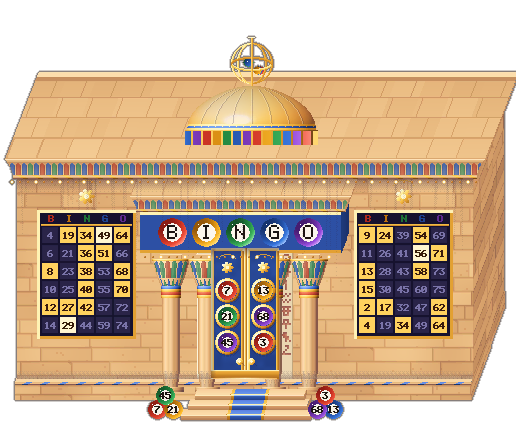
Our hall is a footnote to all this: 75 balls in a golden cage, two prizes, and Seshat — the Egyptian goddess of writing and counting — as patron of the numbers. The rules are on the how to play page, and the differences between the American and British games on 75 vs 90 balls.
No single person. It descends from Italian lotto; Hugh J. Ward ran it at carnivals in Pennsylvania in the 1920s, and Edwin S. Lowe popularised it as bingo from 1929.
The popular story says a winner shouted “bingo” instead of “beano”. Museums call it a legend, and nobody knows for sure where the word came from.
Yes. Lotto goes back to the Italian lotteries of the 16th and 17th centuries; bingo is its American descendant of the 1920s.
After the Betting and Gaming Act 1960. Commercial clubs opened from 1961, many of them in former cinemas and dance halls.
It came to Russia from Europe, probably in the 18th century, and was a common family game in the 19th — Chekhov’s The Seagull (1896) has a lotto scene.
Legs eleven, two fat ladies and the sayings of Russian lotto, with honest notes on their origins.
Read more →American bingo, British tickets and Russian lotto side by side, with average calls to a win.
Read more →Rules of 75-ball bingo, auto and manual halls, and an example game ball by ball.
Read more →14 bingo patterns from a line to blackout, with average balls to win from our simulation.
Read more →
The Hall of Seshat in Anubis City: 75 balls, free debens, and a new game every few minutes.
Play free