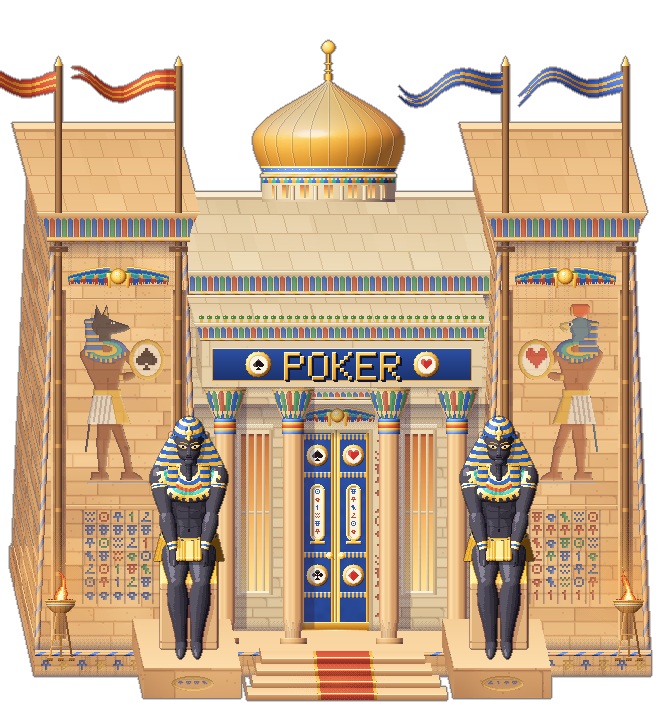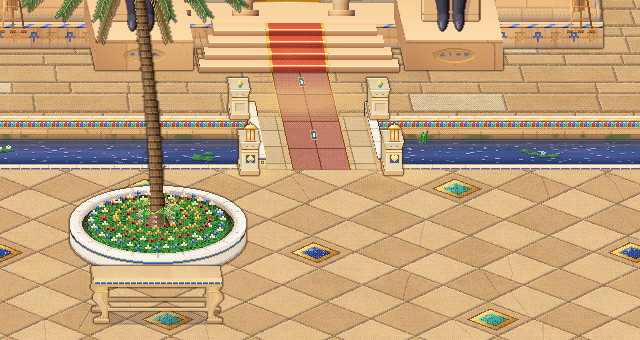
Every stone in Anubis City is now drawn with twice as many pixels, as finely as the temples and the canal. We tried three kinds of paving for each part of the city and kept the best.
- The square — a temple court. Honed sandstone diamonds in two tones, each with its own shade, fine layers, chipped corners and the odd crack. Every fourth diamond holds lapis lazuli flecked with golden pyrite or veined turquoise in a gold setting.
- The quay — Giza limestone. Long pale slabs of the stone the pyramids were built from, with fossil nummulites and the masons’ marks in red ochre.
- The street — an avenue of sphinxes. Sandstone slabs in rows of two widths, a gutter along the kerb, senet boards scratched into the slabs, and here and there a cracked slab replaced with limestone.
The fountain of Anubis was renewed too: a walk of white marble around the basin with lapis corner stones set in gold, a rim with bands of lapis and a twisted gold cord, steps of polished rose granite and a crisp ANUBIS plaque in gold on lapis.
The temples got cleaner too: the carvings and inscriptions on the Temple of Fortune, the Rotunda of Shai, the Hall of Seshat and the House of Hathor are now shaped by the light and shadow of the stone itself. The hieroglyphs are larger, and the thin dark lines that used to shimmer as you walked by are gone.
Lanterns, doorways and torches still pour warm light onto the stone. Take a closer look next time you cross the square — and find more in the city guide.