

Kicker and split pots
When the side card decides, when it does not, counterfeited hands and how a split pot is divided.
Read more →Ten hands from the strongest to the weakest, with the cards from our tables. The odds are exact: our poker engine counted every possible deal.
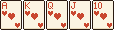
Royal flush, straight flush, four of a kind, full house, flush, straight, three of a kind, two pair, one pair, high card — that is the whole ladder. In Texas Hold’em you make the best five-card hand out of seven cards: your two hole cards and the five on the board. Suits never rank, and only five cards ever count.
The ladder is built on rarity. A hand that turns up less often beats one that turns up more often, which is why a flush outranks a straight and a full house outranks both. Each row below shows the hand with cards from our tables and how often a Hold’em player ends a deal holding it.
Where the percentages come from: our poker engine went through all 133,784,560 possible sets of seven cards and picked the best five in each — an exact count, not a sample. An earlier version of this page used three million random deals, and the figures agreed to within two hundredths of a percent.
The ladder was fixed long before Hold’em, in games where each player got exactly five cards, so it follows five-card odds. With seven cards to choose from, every hand becomes more likely, but not evenly — and that produces one curious exception at the bottom.
| Hand | Five cards dealt | Hold’em: best five of seven |
|---|---|---|
| Royal flush | 0.00015% · 1 in 649,740 | 0.0032% · 1 in 30,940 |
| Straight flush | 0.0014% · 1 in 72,193 | 0.028% · 1 in 3,590 |
| Four of a kind | 0.024% · 1 in 4,165 | 0.17% · 1 in 595 |
| Full house | 0.14% · 1 in 694 | 2.6% · 1 in 39 |
| Flush | 0.20% · 1 in 509 | 3.0% · 1 in 33 |
| Straight | 0.39% · 1 in 255 | 4.6% · 1 in 22 |
| Three of a kind | 2.1% · 1 in 47 | 4.8% · 1 in 21 |
| Two pair | 4.8% · 1 in 21 | 23.5% · 1 in 4.3 |
| One pair | 42.3% · 1 in 2.4 | 43.8% · 1 in 2.3 |
| High card | 50.1% · 1 in 2 | 17.4% · 1 in 5.7 |
Look at the last rows. In a five-card deal, half of all hands are nothing at all. With seven cards you finish with no pair only 17.4% of the time — less often than with two pair (23.5%). High card still ranks lowest, because any pair beats it. Rarity explains the ladder, but the ladder belongs to five-card poker, and nobody re-sorts it for Hold’em.
The top of the table moves as well. A royal flush is about 21 times more likely in Hold’em than in a five-card deal, a full house about 18 times. Even so, 1 in 30,940 is a long wait: a player who reaches the river in 50 hands a day would need, on average, about a year and eight months to make one.
Ties are settled by the best five cards and nothing else. Our engine turns every hand into a single number — the category first, then the ranks that matter, in order — so a tie at our tables means the two numbers are exactly equal, and the pot is split. This is what gets compared in each category:
With four hearts on the board, a single heart in your hand completes a flush, and its rank is what counts. Here the ace of hearts beats the queen and jack of hearts together, because flushes are compared card by card from the top.
A flush beats a straight. Five cards of one suit are harder to collect than five in a row: 3.0% against 4.6% of Hold’em hands, 0.20% against 0.39% in a five-card deal. The same logic puts a full house above both.
With two pair, exactly one kicker plays, and it may well be on the board. On A♥ K♦ 9♣ 9♠ 4♥, a player with A♠ Q♣ and a player with A♦ J♣ both have aces and nines with a king kicker. The queen and the jack never make it into the five cards, so the pot is split.
It works the other way too. On Q♠ Q♦ 9♣ 9♥ 3♠ both players have queens and nines from the board, and now the kicker in hand decides: K♥ 2♣ beats J♦ 8♣. And when the board shows two pairs and you hold a third, higher one, the board’s lower pair drops out: with Q♣ Q♦ on K♠ K♦ 8♣ 8♥ 4♠ you have kings and queens, which beats kings and eights with an ace.
5-4-3-2-A is a straight, the lowest one. The ace plays as a one, so the hand is “five-high” and any straight to the six beats it. On 2♠ 3♦ 4♣ 9♥ K♠, A♦ 5♣ makes the wheel and 6♥ 5♦ makes a six-high straight. This is the only straight where the ace can be low: K-A-2-3-4 does not count.
Sometimes the five community cards are the best hand anybody can make. On 10♠ J♦ Q♣ K♥ A♠ the table shows a broadway straight; pocket aces add nothing, because three of a kind is lower than a straight. Everyone still in the hand plays the board and the pot is split. Before you raise with a hand like that, check whether your own cards play at all.
The costly mistakes with hand rankings are rarely about the order itself. They come from missing what the board allows. Before you call a big bet on the river, run three checks:
If all three answers are “no”, the best possible hand — the nuts — is three of a kind. On K♣ 7♦ 2♠ 4♥ 9♣, for example, nothing beats three kings. That is why a set wins so many big pots on quiet boards, and why a flush draw makes everyone nervous on wet ones. How often draws come in is covered in outs and pot odds.
One page with all ten hands, their Hold’em odds, the tie-break rules and the three board checks. The button prints only the sheet, not the whole page. Keep it next to the keyboard for your first sessions; most players stop looking at it within a week.
Yes. A flush is rarer — 3.0% of Hold’em hands against 4.6% for a straight — so it ranks higher. A full house beats both.
None. In Texas Hold’em suits never break a tie; if the best five cards are equal, the pot is split.
It is the same hand reached in two ways. A set is a pocket pair plus a matching board card; trips are one card in hand plus a pair on the board. Our tables call both “Three of a kind”.
Only in the straight 5-4-3-2-A and the straight flush made of the same ranks. It is the lowest straight, so 6-5-4-3-2 beats it.
No. Your best five out of seven count, wherever they come from. If all five are on the board, you are playing the board, and so may everyone else.
A pair of aces. Against one random hand it wins about 85% of the time, against three about 64% — try any hand in our odds calculator.
When the side card decides, when it does not, counterfeited hands and how a split pot is divided.
Read more →Your chance to win against 1–8 opponents, counted by our engine right in the browser, plus worked examples.
Read more →
All 169 hands with their equity against 1–8 opponents, the top 20 and the classic beginner mistakes.
Read more →
Blinds, the deal, four betting rounds, raises, all-ins and the showdown, with a full example hand.
Read more →More than 120 Hold’em terms, from check and call to gutshot and slow roll, grouped by topic with a search box.
Read more →
The Scribes’ Table plays 50/100 blinds with free debens — the cheapest place to watch these hands come up for real.
Play free