

Hand rankings
All ten hands with real cards, exact odds, tie-break rules and a printable cheat sheet.
Read more →From the blinds to the showdown, with one hand at the Scribes’ Table played card by card.
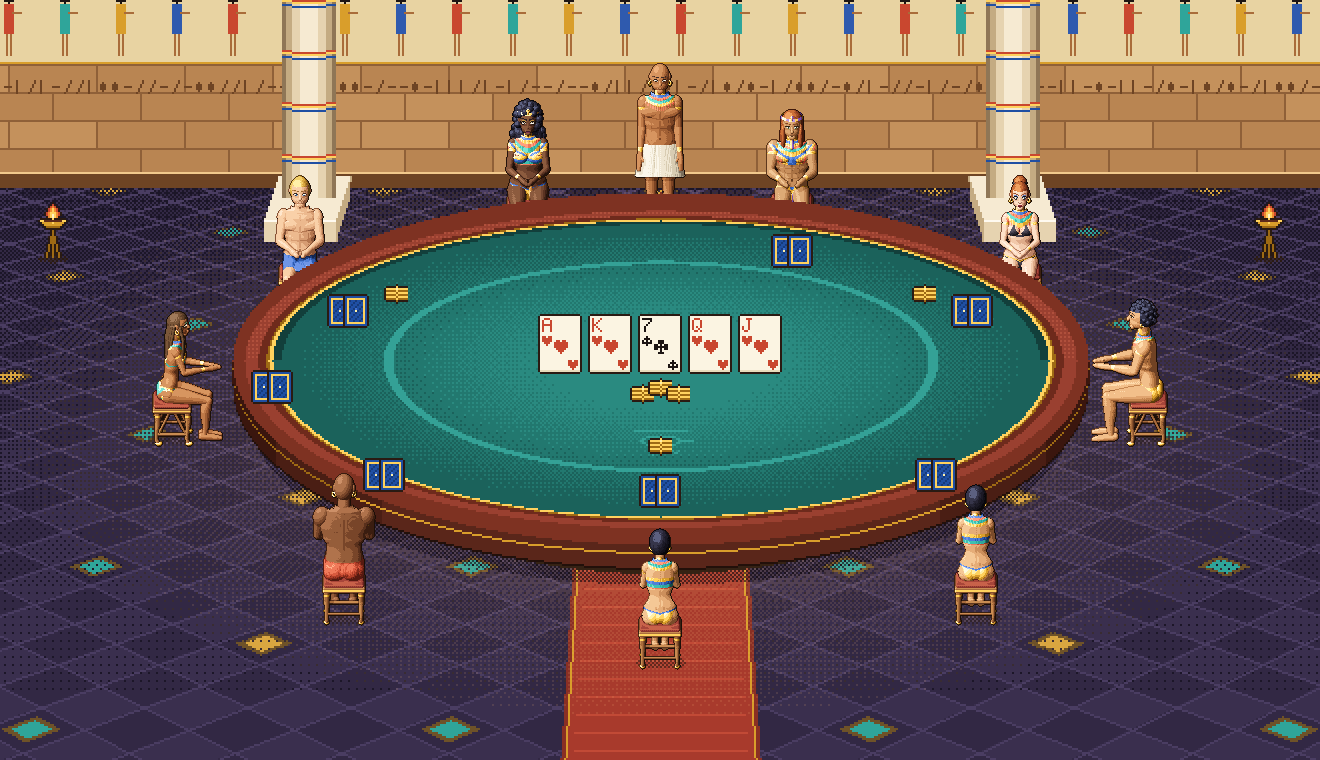
Each player gets two private cards. Five shared cards are dealt face up in the middle: three at once (the flop), then one (the turn) and one more (the river). There is a round of betting before the flop and after each street. You win the pot with the best five-card hand at the end, or by betting until everyone else folds.
You may use both of your cards, one of them or none: the best five out of seven is what counts. That is the whole game. The rest of this page explains the order of play, how much you can bet and what the table does when the hand is over.
A round marker, the dealer button, marks the player who acts last after the flop. It moves one seat to the left after every hand, so everyone gets a turn. The two players to its left post forced bets before any cards are dealt: the small blind and the big blind, which is twice as big. At the Scribes’ Table that is 50 and 100 debens.
The blinds make sure every hand has something in the middle worth fighting for. Without them the best strategy would be to sit and wait for aces forever.
With only two players in the hand the order changes. The button posts the small blind and acts first before the flop; the big blind acts first on every street after it.
At our tables the button simply moves to the next player who is dealt in. A newcomer joins from the next hand and does not post an extra blind. A player who cannot cover a blind posts what he has and is all-in; everyone else still has to call the full big blind.
The dealer gives one card to each player, starting with the player to the left of the button and going clockwise, then a second card the same way. The button gets the last card of each round. These are your hole cards. At our tables they are sent to your screen only, and nobody else sees them unless the hand goes to a showdown.
Before each street of shared cards the dealer burns one card, putting it aside face down. It does not change the odds; it is a habit from live games that stops anyone glimpsing the next card. Our engine burns cards too, so the deck runs in the same order as at a real table.
A round ends when everyone still in the hand has put in the same amount, or is all-in, and everyone has had at least one chance to act. If all players but one fold at any point, that player takes the pot at once and no cards are shown.
| Action | When | What happens |
|---|---|---|
| Fold | Any time | You give up your cards and the chips you have already put in |
| Check | Nobody has bet in this round | You pass without putting chips in |
| Bet | Nobody has bet in this round | You put chips in first, at least the big blind |
| Call | Someone has bet | You match the current bet |
| Raise | Someone has bet | You increase the bet; the others must call, raise again or fold |
| All-in | Any time | You put in every chip you have on the table |
In the game the buttons read Fold, Check or Call, and Bet or Raise to. Next to them sit a slider and quick sizes — Min, ½ pot, ¾, Pot and Max — where Max is the all-in. Our table always writes raises as “raise to”: the number is your total bet for this round, not the amount you add to it.
We play No-Limit Hold’em: at any moment you may bet anything from the minimum up to every chip in front of you. The minimum bet is the big blind. A raise must be at least as large as the previous bet or raise in the same round.
Here is how it works at the Scribes’ Table, where the big blind is 100. A player raises to 350, which is a raise of 250. Anyone who wants to re-raise has to go to at least 600: 350 plus another 250. If someone then makes it 1,200, the step becomes 600, and the next raise must reach at least 1,800.
One exception confuses a lot of players. If someone goes all-in for less than a full raise, the bet goes up, but the players who have already acted in that round may not raise again — they can only call the difference or fold. Players who have not acted yet can still raise. Our table applies this to the chip, and the guide to side pots walks through it with numbers.
Nobody can push you out of a hand for lack of chips. If a bet is bigger than your stack, you call with everything you have. From each opponent you can then win only as much as you put in yourself, and the chips the others keep betting form a side pot that only they can win.
If nobody matches a bet, the unmatched part goes straight back to the player who made it. When fewer than two players can still bet, the remaining shared cards are dealt without any more betting and the hands are shown.
If two or more players are still in after the river betting, they show their cards. Each player’s hand is the best five cards out of their two hole cards and the five on the board — the order of hands is in our hand rankings. The best hand wins the pot; equal hands split it.
In card rooms the last player to bet or raise shows first, and a loser may throw his cards away unseen. At our tables every hand that reaches the showdown is turned face up at once, and the table names the winning combination. When a pot does not divide evenly, the leftover chips go one at a time to the winners, starting with the first one to the left of the button.
Four players at the Scribes’ Table, 10,000 debens each. You are on the button. Ahmose is in the small blind, Nefertari in the big blind, and Ramses is first to act.
Two lessons hide in this hand. Your calls on the flop and the turn were a bet on nine cards, and whether such calls pay is the subject of outs and pot odds. And after the flop Ramses had to act first on every street, while you saw what he did before you decided. That is the advantage of the button, explained in positions.
We played this exact hand through our poker engine with the same cards and bets. The pots and the final stacks above are what it produced.
| Table | Blinds | Buy-in |
|---|---|---|
| Scribes’ Table | 50 / 100 | 1,000 – 20,000 |
| Priests’ Table | 500 / 1,000 | 10,000 – 200,000 |
| Pharaoh’s Table | 5,000 / 10,000 | 100,000 – 2,000,000 |
All chips are free debens. They cannot be bought or cashed out, so the only things at stake are pride and a seat at the Pharaoh’s Table.
Two private cards each, plus five shared cards on the table. You make the best five-card hand from those seven.
No. You can use both, one or none. If the board alone is the best hand, everyone still in splits the pot.
They split the pot equally; suits do not count. If the chips do not divide evenly, the leftovers go one at a time to the winners, starting from the left of the button.
The first player still in the hand to the left of the button. With only two players, that is the big blind.
At least the size of the last full bet or raise in that round, and never less than the big blind. After a raise from 100 to 350, the next raise must go to at least 600.
You have 15 seconds per move at our tables. The table checks for you if it can and folds otherwise; after three missed turns in a row you are marked as stepped away.
All ten hands with real cards, exact odds, tie-break rules and a printable cheat sheet.
Read more →
All 169 hands with their equity against 1–8 opponents, the top 20 and the classic beginner mistakes.
Read more →
Seat names at 9- and 5-seat tables, why the button is the best seat and how many hands to play from each.
Read more →
Main and side pots, worked examples with three and four players, odd chips and a calculator.
Read more →More than 120 Hold’em terms, from check and call to gutshot and slow roll, grouped by topic with a search box.
Read more →
The Scribes’ Table has blinds of 50 and 100 and the debens are free. Sit down and try the rules out.
Play free