

Basic strategy chart
The right move for every hand at our table, how we calculated it and what it saves.
Read more →One ace can count as 1 or 11, and that changes how you play the whole hand.
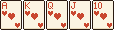
A soft hand has an ace counted as 11: A♠ 6♦ is soft 17. One more card can’t bust it, because the ace can always drop to 1. A hard hand has no ace, or an ace that must count as 1: A♠ 6♦ 9♣ is hard 16. Soft hands are played more boldly — you hit or double where a hard hand of the same total would stand.
A hand only ever goes from soft to hard, never back. Once the ace is forced down to 1, it stays 1 for the rest of the hand.
Soft starting hands — an ace with a 2 to 9 — come up in about one deal in ten (9.5%). Because they are rarer than hard totals, they are the part of the chart people learn last and forget first.
With a hard 16, every card from 6 up busts you. With a soft 16 (A,5), no card can: a ten turns it into hard 16, an ace into soft 17. Hitting a soft hand risks nothing on the next card, so the only question is whether your total is good enough to stand on.
Soft 17 and below are not. The dealer always finishes on 17 or more unless the dealer busts, so a 17 can never beat a dealer who stands — at best it ties — and anything lower wins only on a dealer bust. That is why the chart never stands on soft 17 or less: it hits, or doubles when the dealer shows a weak card.
If you hit and the hand is still soft, keep reading the soft rows, but you can no longer double: D now means hit and Ds means stand. If the hand has turned hard, switch to the hard rows of the full chart.
You hold A♠ 2♥ against a dealer’s 9: soft 13, so hit. The next card is 4♣ — soft 17, still a soft row, still a hit. Then 9♦ arrives: with the ace as 11 that would be 26, so the ace drops to 1 and you have hard 16. Now you read the hard rows, and hard 16 against a 9 says hit again. Three cards in a row, each decision taken from a different row of the chart.
Many players stand on A,6 because 17 “feels” finished. It isn’t. Against a dealer’s 6, standing on soft 17 earns +1.2 per 100 debens, hitting +12.9 and doubling +25.9. Against a ten, standing loses 42.0 per 100, hitting only 19.6.
Over all dealer cards, the habit of standing on soft 17 costs 0.25% of everything you bet — more than half of the whole house edge at our table.
| Dealer shows | Stand | Hit | Double |
|---|---|---|---|
| 2 | +12.4 | +6.3 | +12.1 |
| 3 | +15.1 | +9.1 | +17.9 |
| 4 | +18.0 | +12.4 | +24.9 |
| 5 | +20.3 | +15.2 | +30.4 |
| 6 | +28.0 | +19.1 | +38.3 |
| 7 | +40.2 | +17.2 | +22.4 |
| 8 | +10.8 | +4.1 | −2.8 |
| 9 | −18.3 | −9.8 | −28.5 |
| 10 | −18.0 | −14.3 | −34.3 |
| Ace | −10.0 | −9.5 | −36.3 |
Against a 2, standing beats doubling by three tenths of a deben per 100 — a cell that flips at tables where the dealer hits soft 17. Against an ace, hitting beats standing by half a deben. These are the margins the chart is made of; none of them is worth agonising over, but together they add up.
Soft hands matter for the dealer too. Ours stands on every 17, including soft 17 such as A♣ 6♦ — it is printed on the cloth: “Dealer stands on all 17”. At many tables elsewhere the dealer hits soft 17 instead, which gives the dealer extra chances to improve. By our calculation that rule costs players another 0.21%.
Both: it is soft 17. It counts as 17 until a card would take it over 21; then the ace counts as 1.
Not on the next card. Once the ace has dropped to 1, the hand is hard and can bust like any other.
No. At our table soft 17 is always hit, or doubled against a 3–6.
Blackjack is an ace and a ten-value card as your first two cards, paid 3 to 2. Any other 21 with an ace counted as 11, such as A-5-5, is soft 21 and pays 1 to 1.
No. Our dealer stands on all 17s, soft ones included.
The right move for every hand at our table, how we calculated it and what it saves.
Read more →Hard 9, 10 and 11, the soft doubles, the doubles that cost money, and what doubling is worth.
Read more →Deal a hand, pick a move, see whether the chart agrees and what each move is worth.
Read more →Card values, the deal, your four moves, the dealer’s rules, payouts and a full round.
Read more →
Next time you hold an ace at the Hall of Thoth, check the soft rows before you press Stand.
Play free