

Payouts and odds
Every bet with its payout, true odds, probability and the 2.70% house edge.
Read more →The rules as they work at the tables of the Rotunda of Shai in Anubis City — from your first chip to the moment the ball settles.
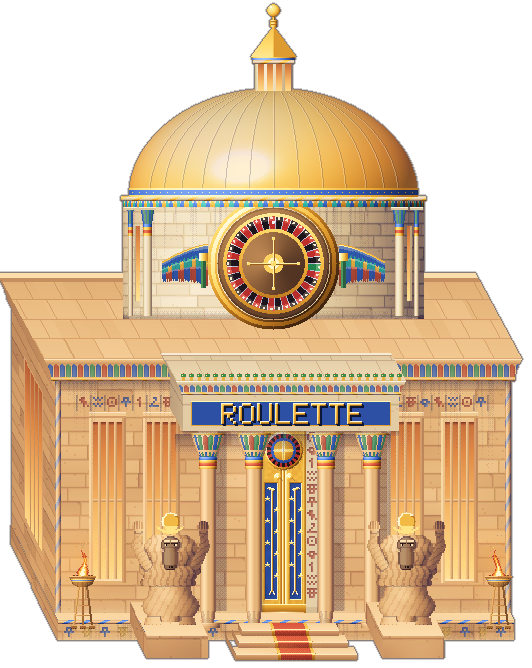
Place chips on the layout while the betting timer runs — on one number, a group of numbers or a colour. Then the wheel spins and the ball settles in one of 37 pockets, 0 to 36. Every bet that covers that number wins: 35 to 1 for a single number, down to 1 to 1 for red or black.
That is the whole game. The rest of this page is about playing it with confidence: where exactly a chip goes, what the limits are, how our timed round works and how a win is counted. If you only need the odds, they are in Payouts and odds.
The cloth is a grid of 36 numbers in three rows of twelve (on a phone the game turns it into twelve rows of three), with zero at the head. Red and black follow a fixed pattern: 1, 3, 5, 7, 9, 12, 14, 16, 18, 19, 21, 23, 25, 27, 30, 32, 34 and 36 are red, the other eighteen are black, and zero is green. Around the grid sit the outside bets: three columns marked “2 to 1”, three dozens and six even chances.
Where the chip lies decides the bet. The middle of a cell is a single number. A border between two cells is a split. A crossing of four cells is a corner. The outer edge of a row is a street — the three numbers of that row — and the same edge where two rows meet is a line of six. Along zero you also have the splits 0–1, 0–2 and 0–3, the trios 0–1–2 and 0–2–3, and the corner 0–1–2–3, known as the first four. Count them all and you get 157 places; the server accepts exactly those and nothing else.
Hover over the cloth in the game — or hold a finger on it on a phone — and the table lights up the numbers your chip would cover and shows the payout, for example “Split 17–20 · 17 : 1”. Use it until the geometry becomes second nature.
Bets on the numbers themselves — straight up, split, street, corner and line — are called inside bets. They win rarely and pay a lot. Columns, dozens and the even chances (red or black, even or odd, 1–18 or 19–36) are outside bets: they cover 12 or 18 numbers, win often and pay 2 to 1 or 1 to 1.
Zero belongs to no outside bet. It is neither red nor black, neither even nor odd, and it sits in no dozen or column — so when the ball lands on 0, every outside bet loses. That single pocket is where the house edge comes from.
The Rotunda of Shai has three tables, and they differ only in stakes. The smallest chip of a table is also its smallest bet, and every amount on a spot must be a multiple of it.
| Table | Chips | One inside spot | One outside spot | Per spin |
|---|---|---|---|---|
| Scribes’ Table | 100 · 500 · 1,000 · 5,000 | up to 1,000 | up to 5,000 | up to 10,000 |
| Priests’ Table | 1,000 · 5,000 · 10,000 · 50,000 | up to 10,000 | up to 50,000 | up to 100,000 |
| Pharaoh’s Table | 10,000 · 50,000 · 100,000 · 500,000 | up to 100,000 | up to 500,000 | up to 1,000,000 |
So the biggest win from one chip stack at the Scribes’ Table is 35,000 (1,000 on a number), and at the Pharaoh’s 3,500,000. A new player starts with 100,000 debens, which makes the Scribes’ Table the natural first stop. Up to 40 people share a table; when it is full, an identical one opens next to it.
There is no spin button. The table runs on its own clock, like a live croupier: 20 seconds of betting, “No more bets”, seven seconds of spinning, six seconds of result — and the timer starts again. One player at the table or forty, the rhythm is the same, so a spin comes roughly every 33 seconds, about 108 an hour.
While the timer runs you can add chips, take back the last one (Undo, or the Z key), clear everything, repeat the previous spin’s bets (R) or double all of them (×2, or D). In the last five seconds the timer turns red. A chip placed at the very last moment still counts: the table closes bets 0.3 seconds after the timer reaches zero, to allow for the connection.
Until “No more bets” your chips are only a request — nothing has left your balance yet. Get up from the table while bets are open and they simply come back.
A winning bet returns your stake plus the payout. A 100 chip on a number that comes up brings back 3,600: 3,500 of winnings and your own 100. A 100 chip on red brings back 200. Losing chips are swept away.
In our game the money moves before you see the ball. At “No more bets” the server draws the number with a cryptographically secure random generator and, in one transaction per player, takes the stakes and credits the returns. Only then is the number sent to the table and the wheel starts turning. When the ball settles, the result badge shows what came back — for example “+3,600” — and your balance updates.
The “+” on the badge is everything returned to you, stake included. For your profit on the spin, subtract what you had on the cloth.
Say you get four bets down before the timer runs out:
That is 1,800 on the cloth, within every limit of the table. The ball drops into 19, a red number.
| Bet | Stake | Result | Comes back |
|---|---|---|---|
| Red | 500 | wins 1 to 1 | 1,000 |
| Number 19 | 100 | wins 35 to 1 | 3,600 |
| Corner 19–20–22–23 | 200 | wins 8 to 1 | 1,800 |
| Third dozen | 1,000 | loses | 0 |
| Total | 1,800 | 6,400 |
The badge reads +6,400, and your profit for the spin is 6,400 − 1,800 = 4,600. Had the ball found 20, only the corner would have paid — 1,800 back, exactly what you staked. On 25 you would collect for red and the dozen, 4,000 in all. And on zero all four bets lose: none of them covers it.
Spread like this, the set covers 26 of the 37 numbers but finishes the spin ahead on only 14 of them. You can check any combination like this one in the bet calculator.
Some European tables soften zero for even-money bets: under La Partage you get half your stake back, under En Prison the bet stays for one more spin. Our tables use neither — on zero an outside bet simply loses. What those rules are worth is worked out in Payouts and odds.
The table remembers the last 20 numbers and keeps statistics over 100 spins: red against black, zero, even and odd, “hot” and “cold” numbers. It is fun to look at and useless for prediction. Every number is drawn independently of the ones before it, and a number that has not come up for 80 spins still has the same 1 in 37 chance as any other.
Yes. Zero is a number like any other: straight up it pays 35 to 1, and it is part of the splits 0–1, 0–2 and 0–3, the trios 0–1–2 and 0–2–3 and the first four, 0–1–2–3.
The smallest chip of the table: 100 at the Scribes’ Table, 1,000 at the Priests’ and 10,000 at the Pharaoh’s. Every amount must be a multiple of it.
No. At that moment the number is already drawn and every bet is settled; the screen stops sending chips once the timer reaches zero.
Nothing is lost. If bets were already closed, the spin is settled and any winnings are in your balance; if the timer was still running, your chips stay on the cloth and play.
No. Our layout has the 157 standard spots. Call bets such as Voisins du zéro are just sets of splits and corners, and you can place them by hand — see Payouts and odds.
Every bet with its payout, true odds, probability and the 2.70% house edge.
Read more →Place chips and see the result on every number, your average loss and your chance after N spins.
Read more →Single, double and triple zero compared: edges, wheels and losses per 100 spins.
Read more →A million simulated sessions of six betting systems at our table limits — and why none beats the edge.
Read more →
Walk to the golden dome of the Rotunda of Shai, sit down at the Scribes’ Table and place your first chip before the timer runs out.
Play free